The best things to do in Chicago on a school trip are the Kenneth C. Griffin Museum of Science and Industry, an architecture river cruise, the Skydeck at Willis Tower, the Field Museum, the Art Institute of Chicago, Navy Pier and Millennium Park. Most groups fit five or six of them into three days without rushing.
Chicago rewards a group that knows why it is standing somewhere. This page gives you the stop and the thing worth saying at it.
The short version:
- Griffin Museum of Science and Industry — a real German submarine, indoors
- Architecture river cruise — the single best hour in the city
- Skydeck at Willis Tower — four states from the 103rd floor
- Field Museum — SUE, the most complete adult T. rex found
- Art Institute of Chicago — the American and Impressionist collections
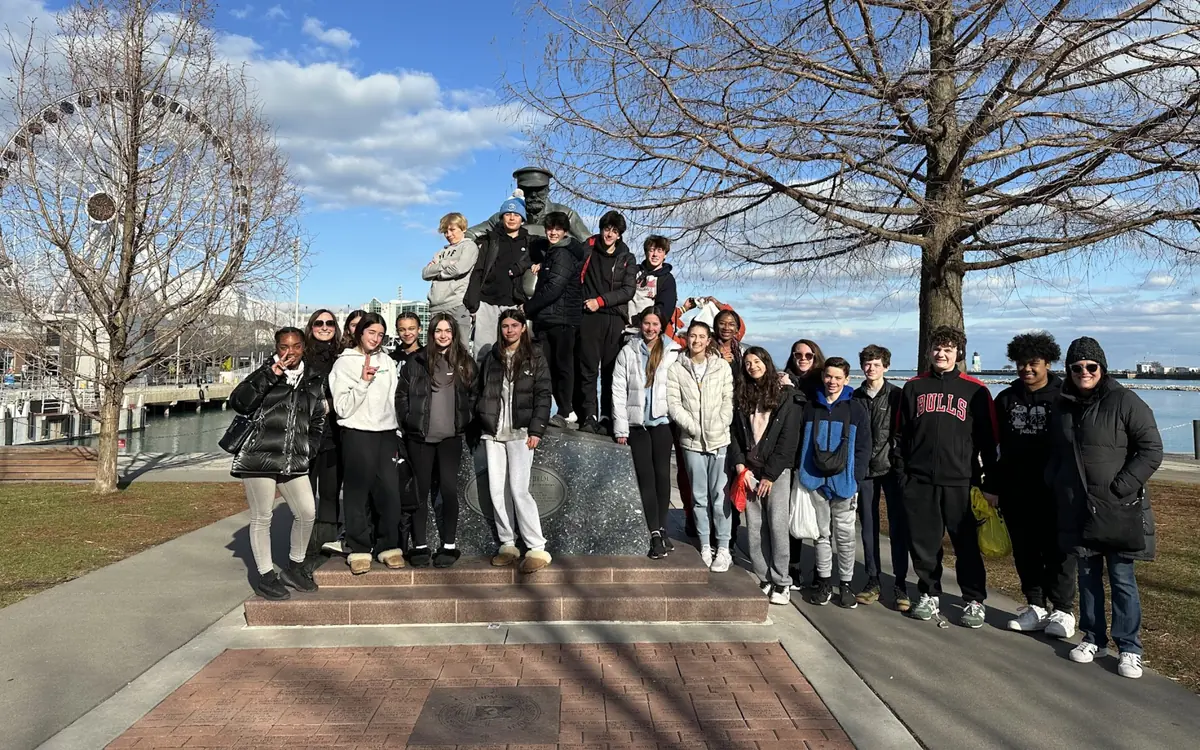
- Navy Pier — the Centennial Wheel and the lakefront
- Millennium Park — Cloud Gate, in fifteen minutes
Below is each stop, what students actually see, and how the days fit together. You can request a quote at no cost before committing to anything.
Chicago School Trips at a Glance
| Item | Detail |
|---|---|
| Core stops | Griffin Museum of Science and Industry, architecture river cruise, Skydeck at Willis Tower, Field Museum, Art Institute, Navy Pier, Millennium Park |
| Typical trip length | Three days covers the core. Five days adds Wrigley Field, the Shedd Aquarium and a neighborhood |
| Strongest curriculum fit | STEM and engineering, architecture, art history, American history, Spanish language |
| Getting around | Compact downtown. Most of the core sits between the Loop, the lakefront and the Museum Campus |
| Best season | Spring and fall. Lake wind makes winter colder than the forecast suggests |
| The underrated one | The architecture river cruise. It explains the whole city in about ninety minutes |
| Landmark programs | Three Chicago itineraries, including a Spanish immersion program |
The Seven Chicago Stops Worth Building a Trip Around
These are the stops that earn their place, and they appear across our Chicago school trips. For each one, what students see and the detail worth telling them.
| Stop | What students see |
|---|---|
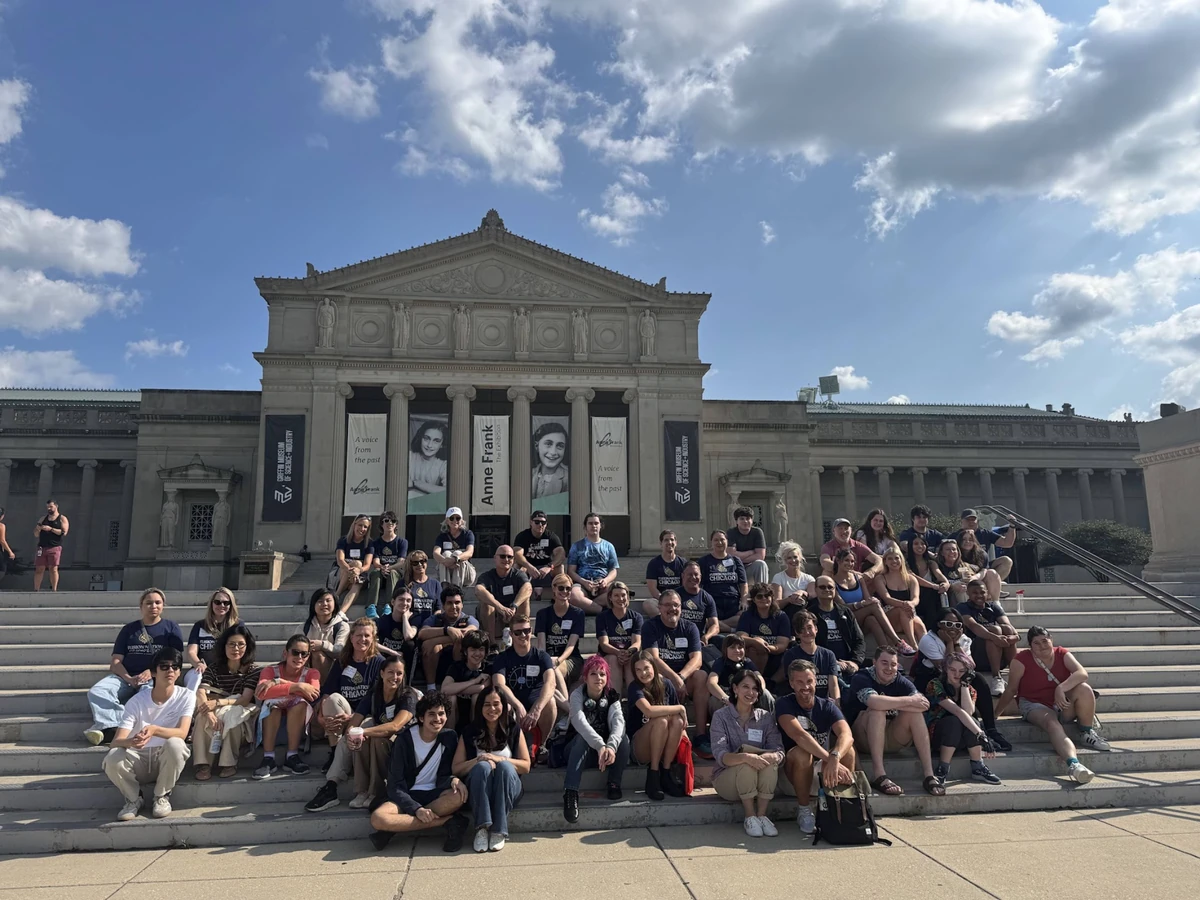
| Griffin Museum of Science and Industry Hyde Park | A captured German U-boat sitting indoors, a working coal mine dating to the museum’s 1933 opening, and 1.2 million square feet of floor space. The building itself is the Palace of Fine Arts, built for the 1893 World’s Columbian Exposition |
| Architecture river cruise Chicago River | The skyline explained from water level, building by building. Students who have been told what a skeleton frame is will see the idea develop along the riverbank |
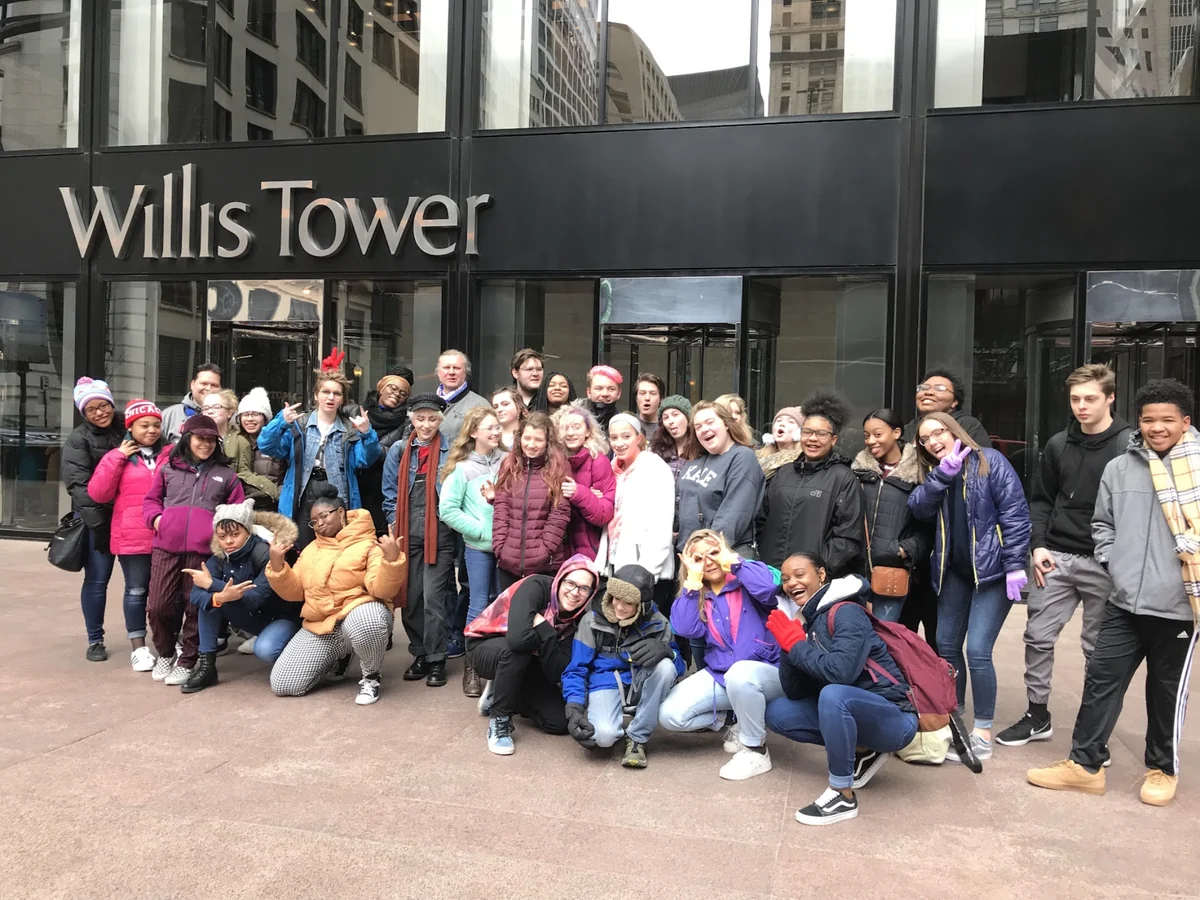
| Skydeck at Willis Tower The Loop | The Ledge: a glass box suspended 1,353 feet up that extends 4.3 feet out from the building, standing on glass about an inch and a half thick. On a clear day the view reaches four states and about 50 miles |
| Field Museum Museum Campus | SUE, the most complete adult Tyrannosaurus rex skeleton yet found, discovered in South Dakota in 1990. Also Egyptian galleries and the evolution halls |
| Art Institute of Chicago Michigan Avenue | One of the strongest Impressionist collections outside France, plus American Gothic and Nighthawks. For an art class this is the anchor stop |
| Navy Pier Lakefront | The Centennial Wheel, Lake Michigan and room for a group to spread out. The stop students relax at, which matters on day two |
| Millennium Park The Loop | Cloud Gate, the Pritzker Pavilion and Buckingham Fountain nearby. Fifteen minutes that produces most of the trip photographs |
Our guide to educational field trips in Chicago and the city’s STEM museums go further on individual sites.
Why the Architecture Cruise Is the One Not to Skip
If a group can only do one thing, do this. It is the stop teachers are most often surprised by.
Chicago burned in 1871. What went up afterwards was the beginning of the tall building, and the river runs straight through the result.
The Home Insurance Building of 1885 is generally counted among the world’s first skyscrapers, because its weight was carried by an iron skeleton rather than by thick walls. That idea is why cities look the way they do.
There is a useful irony for students: that building was demolished in 1931. The thing that started it all is gone, and the cruise is a tour of everything it made possible.
Ninety minutes on the water does what a week of slides cannot, and a group of forty can all see at once.
Chicago for a Spanish Class
This is the Chicago argument almost nobody makes, and it is a strong one.
Spanish is taught in 79% of U.S. public high schools, far more than any other world language. Most Spanish classes never get a trip, because the obvious destinations need passports, longer calendars and bigger budgets.
Chicago is a domestic answer. Pilsen is a Mexican-American neighborhood with a mural tradition and the National Museum of Mexican Art, and students can use the language the same day they land.
Landmark runs a Chicago Spanish immersion school trip built around exactly that: a guided Pilsen mural walking tour and a docent-led visit to the National Museum of Mexican Art. Our Pilsen murals walking tour piece covers the neighborhood, and six Chicago neighborhoods for cultural immersion covers the wider city.
Matching Stops to What You Teach
A trip tied to a unit is easier to justify and easier for students to absorb.
| The unit | Where to go |
|---|---|
| Physics and engineering | Griffin Museum of Science and Industry, then the Skydeck for structure at scale |
| Architecture and design | The river cruise, then Millennium Park |
| Earth science and biology | Field Museum and the Shedd Aquarium, which sit beside each other |
| Art history | Art Institute of Chicago, with the Impressionist and American rooms |
| Spanish language | Pilsen and the National Museum of Mexican Art |
| American history | The 1871 fire, the 1893 Exposition and the rebuilt city, read along the river |
| Astronomy | Adler Planetarium, on the same Museum Campus point |
| A mixed group | Science museum, river cruise and Navy Pier. It satisfies most of a year group |
Our Chicago school trips are built around these pairings.
How a Chicago Itinerary Fits Together
Chicago is compact, which means the mistake is overfilling rather than underfilling.
| Length | What fits |
|---|---|
| Three days | Navy Pier and the Magnificent Mile on arrival; the river cruise, Millennium Park and the Skydeck on day two; the science museum before departure |
| Five days | The above plus the Shedd Aquarium, the Art Institute, a Cubs game at Wrigley Field and a lake cruise |
| One free afternoon | Worth protecting. The Museum Campus or the lakefront absorbs it well |
| What to cut first | A second museum. Two in one day is one too many for most groups |
Landmark’s three-day Chicago student tour and five-day Windy City tour follow roughly this shape.
What Catches Groups Out
Four things that are easier to know in advance than to discover on day one.
The wind off the lake is real. Lakefront stops in spring and fall run colder than the forecast. Students who packed for the temperature rather than the wind regret it at Navy Pier.
The museums are not downtown. The Field, the Shedd and the Adler sit together on the Museum Campus, and the Griffin is further south in Hyde Park. Those are coach rides, not walks.
Two museums in a day is a stretch. Each of the big ones can absorb three hours. Groups that schedule two tend to rush both.
The name changed. The Museum of Science and Industry was renamed the Kenneth C. Griffin Museum of Science and Industry in 2024. Older guides and some signage still use the former name.
Landmark holds the entries and the timings, so none of this becomes a teacher’s problem. Our travel safety and support page sets out the protocols.
What a Landmark Trip Includes
A package typically covers a private group tour for your group only, a custom itinerary built around your curriculum, transportation, student-appropriate hotel accommodations, admission to every scheduled site, the meals named in the itinerary, a professional Tour Director traveling with your group, and restaurant and driver gratuities.
On average, Landmark’s fully inclusive trips range from $300 to $400+ per traveler per day, or about $1,200 to $3,500+ total for an all inclusive package. Airfare is an additional variable cost. See what a school trip package includes.
Who Is Landmark Educational Tours?
Landmark Educational Tours is a 100% employee-owned domestic and international educational travel company headquartered at 1 Central Street, Suite 205, Middleton, Massachusetts, reachable at (888) 886-2781.
Landmark plans and operates fully managed, custom class trips for public districts alongside private, religious, prep and independent schools. Every trip is a private group tour, and each group travels with a Landmark Tour Director who is an employee of the company.
Landmark is a member of the Student & Youth Travel Association (#13443), along with ABA Member #84360, IATA Code 22576046, BBB Business ID 544197, California Seller of Travel 2168995-50, and ETOA membership. More on the about Landmark page.
Planning a Chicago Trip
Three things make a first conversation productive: a rough headcount, the unit the trip supports, and whether you want three days or five.
A Landmark Travel Consultant will build the itinerary around what your class is studying, free, with nothing held until you say so.
If you have not started, how to start planning a student trip is the step before choosing stops, and what the research says about student travel covers why the prepared ones last.