Italy is the better student trip if your group is studying ancient history, Latin, art history or the Renaissance. France is the better student trip if your school teaches French, or if your focus is revolution, modern European politics or impressionist art. Neither country wins outright. The subject you teach decides it.
Most pages on this question compare the two countries as holidays. This one compares them as classrooms, and uses the one piece of data that settles it for most schools.
The short version:
- The language question is not close. French is taught in 34% of U.S. high schools. Italian is taught in 3%.
- Italy wins on antiquity and art — Rome, Pompeii, Florence. Nowhere else puts that much of the curriculum within walking distance.
- France wins on civics and revolution, and on being a single-base trip that is easier on a first-time group.
- Italy is the heavier walk. A Rome, Florence and Venice itinerary is three cities and three hotels; Paris can be one.
- Latin classes point at Italy, and Latin is taught in more U.S. high schools than Italian is.
Below is the full comparison, subject by subject, with the practical differences that show up on the ground. You can request a quote at no cost before committing to anything.
Italy vs France for a Student Trip at a Glance
| Item | Detail |
|---|---|
| Best for | Italy: ancient history, Latin, art history, the Renaissance, archaeology. France: French language, revolution and civics, impressionist and modern art |
| Language in U.S. high schools | French is offered by 34% of public high schools; Italian by 3% |
| Typical trip length | Italy: 6 to 10 days, depending on how many cities. France: around 9 days for Paris and the Riviera |
| Cities per trip | Italy is usually multi-city. France can be run from a single base in Paris |
| Walking load | Higher in Italy. Rome and Florence are walked; Pompeii is uneven ground |
| World Heritage | Italy has more UNESCO World Heritage Sites than any other country. France is also in the top five |
| Landmark programs | Seven Italy itineraries; one flagship France itinerary covering Paris and the French Riviera |
Italy vs France, Side by Side
The quick version, for anyone deciding in a department meeting.
| Italy | France | |
|---|---|---|
| Strongest subjects | Latin, ancient history, art history, the Renaissance, archaeology | French language, revolution and civics, modern art, STEM |
| Taught in U.S. high schools | Italian: 3% | French: 34% |
| Shape of the trip | Usually multi-city | Can run from one base |
| Walking load | Heavier | Lighter |
| First trip abroad | Workable | Slightly easier |
| Landmark programs | Seven itineraries | One flagship itinerary |
The Language Question Decides It for Most Schools
If your group contains a French class, this is not a close call, and the reason is in the national data rather than in anyone’s opinion.
ACTFL’s State of K-12 World Language Education, drawing on the federal School Pulse Panel survey, reports that among U.S. public high schools, 34% offer French and 3% offer Italian. Across all public schools that teach a world language, French is at 12% and Italian around 1%.
In practical terms: a French class can order lunch, ask directions and read a museum label in Paris. Almost no American student group can do that in Italian, because almost no American school teaches it. For the schools that do, Landmark runs an Italian language and culture immersion.
There is a regional wrinkle worth knowing. In the Northeast, where many of our schools are, the same research puts French at 20% and Italian at 5% of all schools — Italian is better represented here than nationally, but French still leads by a wide margin.
| Language | Share of high schools |
|---|---|
| Spanish | 79% |
| French | 34% |
| American Sign Language | 14% |
| German | 12% |
| Chinese | 6% |
| Latin | 4% |
| Japanese | 4% |
| Italian | 3% |
Notice the row above Italian. Latin is taught in more U.S. high schools than Italian is, and a Latin class’s subject is Rome. That is the Italy argument, and an 8 day Italy itinerary serves it directly. It is a strong one — it is simply not a conversational-language argument.
What Italy Does Better
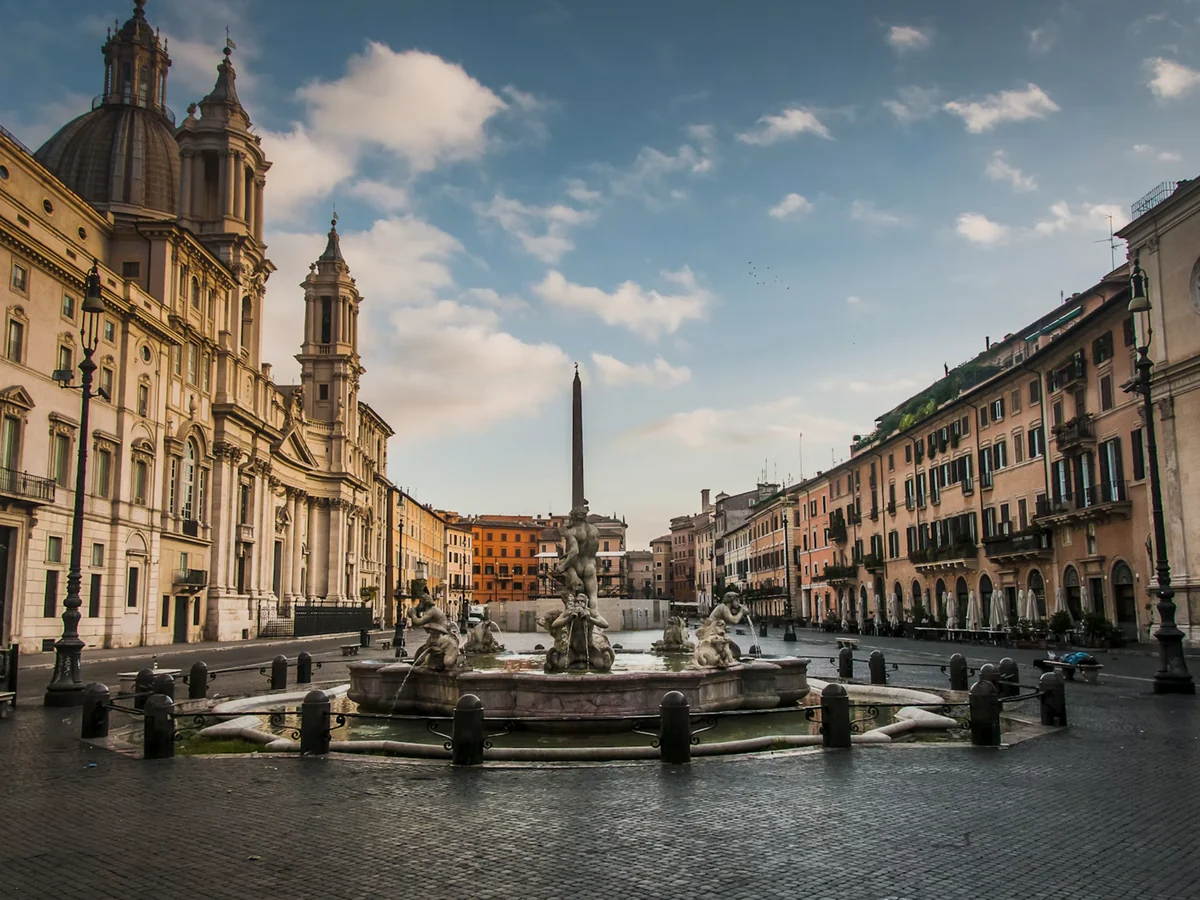
Italy’s advantage is density. The curriculum is not spread across the country; it is stacked in three cities.
Antiquity you can walk into. The Roman Forum, the Colosseum and the Palatine are a single morning. For a Latin or ancient history class, the text stops being a text.
Pompeii has no equivalent anywhere. An excavated Roman town, with streets, shops, graffiti and houses, does in one afternoon what a term of reading cannot.
The Renaissance in one city. Florence holds Brunelleschi’s dome, Michelangelo’s David and the Uffizi within a few streets of each other. An art history unit can be taught on foot.
More UNESCO World Heritage Sites than any other country. That is a reasonable proxy for how much of what students study is physically there.
Our Italy school trips run seven different itineraries, including a classical Rome and ancient history tour and a Renaissance Florence art program.

What France Does Better
France’s advantages are different in kind. They are about language, ideas and logistics rather than ruins.
Students can use the language. With French in a third of U.S. high schools, a France trip is often the only time a class gets to use what it has studied for three years.
Revolution and civics. France is where liberty and equality stopped being theory. For a government or modern European history unit, Paris is the primary source.
The art runs later. If your syllabus is impressionism and the modern era rather than the Renaissance, the Louvre, the Musée d’Orsay and Versailles are the stronger set.
One base, less packing. Paris can anchor a whole trip. For a first-time group, a nervous administration or a younger year group, not moving hotels every two nights matters more than it sounds.
Our France school trips center on the Paris and French Riviera educational tour, and our guide to the best educational attractions in France goes site by site.
Matching the Trip to What You Teach
This is the table to bring to a department meeting.
| The unit | Go to |
|---|---|
| Latin | Italy. Rome and Pompeii, without question |
| French language | France. The only trip where students use the language daily |
| Ancient and classical history | Italy. The Forum, the Colosseum, Pompeii, Herculaneum |
| Renaissance art and humanism | Italy. Florence is the subject, not an illustration of it |
| Impressionism and modern art | France. The Musée d’Orsay and the Louvre |
| Revolution, government and civics | France. Versailles and Paris read as one argument |
| Archaeology | Italy. Pompeii and the Bay of Naples |
| Religious studies | Italy. The Vatican, Assisi and Rome’s basilicas |
| Architecture | Either. Gothic and Beaux-Arts in France; classical and Renaissance in Italy |
| STEM | France has the edge, with science museums and the observatories of the Côte d’Azur |
The Practical Differences
Subject fit decides the country. These decide whether the trip runs well once you are there, and our FAQ covers how private group tours are run.
| Factor | How they differ |
|---|---|
| Cities per trip | Italy itineraries usually move between two and four cities. A France trip can run from one Paris base, or pair Paris with the Riviera |
| Walking | Italy asks more of a group. Rome is walked, Florence is walked, and Pompeii is uneven ancient paving |
| Hotel changes | More frequent in Italy. Every change costs a morning and tests a group’s organization |
| Summer heat | Rome, Florence and Pompeii are hot and shadeless in June. Paris is more forgiving |
| Food and fussy eaters | Italy is usually the easier sell to a group of teenagers, which matters more on day five than anyone expects |
| Crowds | Both are busy in high season. Landmark holds the entries, so the queue is not a teacher’s problem |
| First international trip | France, slightly, on the strength of one base and a language students may know |
Either way, Landmark manages group air, airport transfers and every connection, and a Tour Director travels with the group from start to finish with 24/7 support behind them. Our travel safety and support page sets out the protocols.

What If You Want Both?
It is a fair question, and the honest answer is that it depends how long you have.
In seven days, no. Two countries in a week produces a coach tour, not a study trip, and the thing students remember is the travel between them.
In ten days or more it becomes reasonable, particularly if you anchor on one country and add a few days of the other rather than splitting evenly.
Before adding a second country, ask whether a second city in the same one would serve the syllabus better. Usually it does. Our piece on the best international school trip destinations sets both countries against the wider field.

Which Is Better for a First International Trip?
If the group has never flown abroad together, France has a small edge, for three reasons that have nothing to do with the sights.
Students may already speak some of the language. The trip can run from one hotel. And a nervous parent evening is easier when the itinerary has fewer moving parts.
That said, plenty of first-time groups go to Italy and do well. The deciding factor is usually the year group, not the country. For how to approach the first one, see how to start planning a student trip and what the research says about student travel.
What a Landmark Trip Includes
A package typically covers a private group tour for your group only, a custom itinerary built around your curriculum, transportation, student-appropriate hotel accommodations, admission to every scheduled site, the meals named in the itinerary, a professional Tour Director traveling with your group, and restaurant and driver gratuities.
On international programs Landmark also books group air, airport transfers and every connection, so the group travels as one unit.
On average, Landmark’s fully inclusive trips range from $300 to $400+ per traveler per day, or about $1,200 to $3,500+ total for an all inclusive package. Airfare is an additional variable cost. See what a school trip package includes.
Who Is Landmark Educational Tours?
Landmark Educational Tours is a 100% employee-owned domestic and international educational travel company headquartered at 1 Central Street, Suite 205, Middleton, Massachusetts, reachable at (888) 886-2781.
Landmark plans and operates fully managed, custom class trips for public districts alongside private, religious, prep and independent schools. Every trip is a private group tour, and each group travels with a Landmark Tour Director who is an employee of the company.
Landmark is a member of the Student & Youth Travel Association (#13443), along with ABA Member #84360, IATA Code 22576046, BBB Business ID 544197, California Seller of Travel 2168995-50, and ETOA membership. More on the about Landmark page.
Choosing Between Them
Start with the syllabus rather than the brochure. Name the unit the trip supports, and the country usually names itself.
If you are still torn, the tiebreaker is the language. A French class should go to France. A Latin or art history class should go to Italy.
A Landmark Travel Consultant will build either itinerary around what your class is studying, free, with nothing held until you say so. Our Europe school trips cover both countries and the rest of the continent.