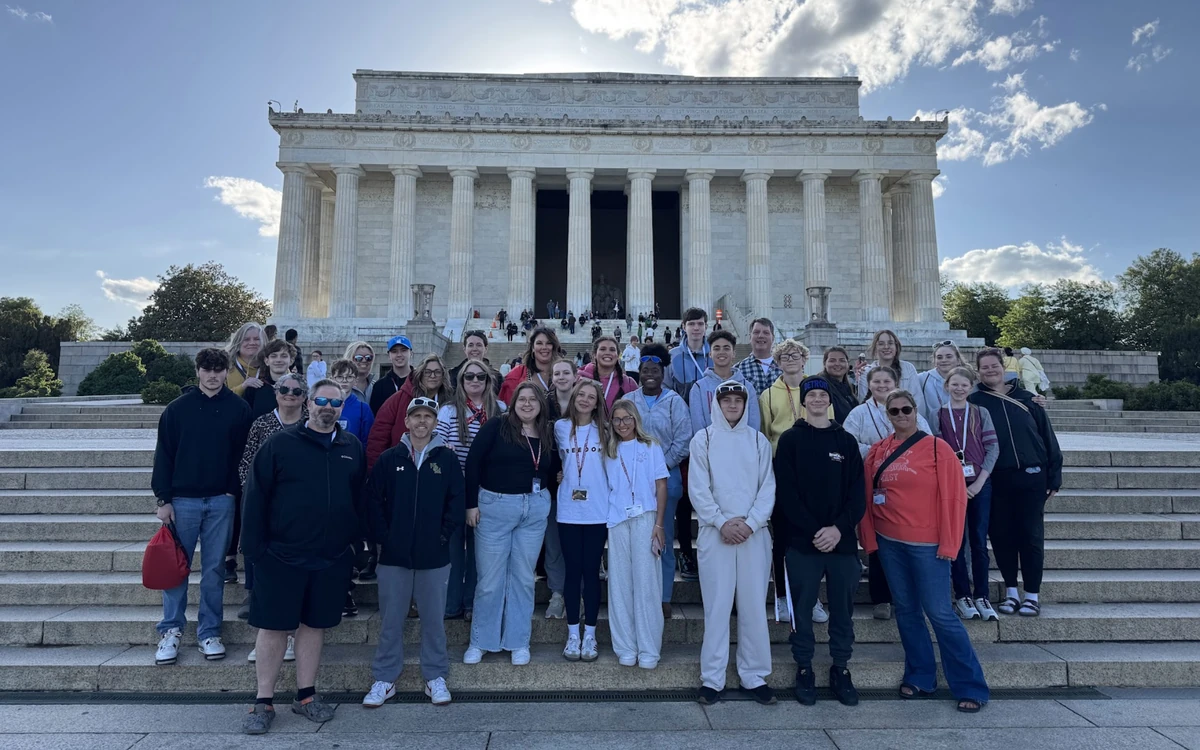
A 3-day school trip with Landmark Educational Tours generally costs $300 to $400+ per student per day, which works out to roughly $900 to $1,200+ per student for the full three days. That is a fully inclusive price — transportation, hotel, meals, attractions, and a Landmark Tour Director traveling with the group. Airfare, when a trip needs it, is quoted separately because it moves with the calendar in a way ground costs do not.
Three days is the most common shape for a first overnight trip, and it is the length most teachers price first. It is long enough to reach a real destination, spend two full days in it, and get home — without the extra night that pushes a trip past what many families will approve.
The number on the permission slip is what actually matters, though, and that number is built from parts. Below is what those parts are, what is in the price, what sits outside it, and the five things that move it in either direction. If you have not picked a destination or dates yet, how to start planning a student trip covers the steps that come before a price.

What a 3-Day School Trip Costs at a Glance
| Item | What to expect |
|---|---|
| Per traveler, per day | $300 to $400+, fully inclusive |
| Three days, all in | Roughly $900 to $1,200+ per traveler |
| Airfare | Quoted separately; varies by origin and date |
| Room basis | Students four to a room by default; adults in singles |
| Group size | Ten travelers is the usual threshold for group rates |
| Gratuities | Not included; budgeted separately for Tour Director and step-on guides |
| When to book | Nine to twelve months ahead; sixty days before departure is the floor |
Landmark trips across all lengths run about $1,200 to $3,500+ in total, so a three-day trip sits at the bottom of that band. A longer trip, a farther destination, or a heavier itinerary is what moves a group up it.
3-Day, 4-Day, and 5-Day School Trip Costs Compared
Because the per-day rate is the constant, trip length is the cleanest way to see how a per-student price is built. The figures below are that rate carried across the common trip lengths.
| Trip length | Nights | Estimated per student |
|---|---|---|
| 3 days | 2 | About $900 to $1,200+ |
| 4 days | 3 | About $1,200 to $1,600+ |
| 5 days | 4 | About $1,500 to $2,000+ |
These are planning ranges carried from the $300 to $400+ per student per day rate, not quotes, and they exclude airfare. A written quote for your group, dates, and itinerary is the only number you should put in front of families.
If four days is the option you are actually weighing, how much a 4-day school trip costs works that length through in full. Read across that table and the shape of the decision becomes clear. Each additional day costs roughly the same as the last in absolute terms, but it buys proportionally more, because the fixed costs of getting your group there and staffing the trip are already paid on day one.
What Is Included in the Price
Landmark quotes fully inclusive trips rather than a base rate with add-ons, which is why the per-day number looks higher than a bare transportation-and-hotel estimate. Here is what the per-traveler price covers.
| Included | What it covers |
|---|---|
| Transportation | Motorcoach, and where an itinerary calls for it, Amtrak, metro, subway, transit bus, train, and light rail. Airfare can be included but is quoted separately. |
| Hotel accommodations | Two nights for a three-day trip. Hotel availability is confirmed at the time of group deposit. |
| Meals | Included, apart from any extra meals a group chooses to add. |
| Sites and attractions | Every scheduled admission on your itinerary, booked in advance. |
| Landmark Tour Director | A Landmark employee, background-checked, traveling with your group for the entire trip. |
| Landmark gear | A Landmark string bag, a reusable water bottle, and a safety bracelet for each traveler. |
| Support | 24/7 support while you are traveling. Optional travel protection underwritten by battleface Insurance Services is available separately. |
What is not included
Two costs sit outside the price and should go into your budget from the first draft. Gratuities for your Tour Director and any step-on guides are not included. And on an overnight trip, chaperone rooms have to be paid for by somebody — either spread across student pricing or covered by fundraising. Decide which before you publish a number. What is included in a school trip package goes through the full list.
What Moves the Price of a 3-Day Trip
Two groups can take the same three-day trip and pay meaningfully different amounts per student. Five things account for most of the gap.
| Factor | Effect on price | Why |
|---|---|---|
| Distance from the destination | Large | A drive-in trip and a fly-in trip are different products. Airfare is the single biggest swing on a short trip, because it is spread over three days rather than seven. |
| Group size | Large | The motorcoach and the Tour Director are fixed costs. Spreading them across more travelers lowers the per-student price. |
| Time of year | Moderate to large | Peak spring weeks carry the highest hotel rates in most destinations. Fall and winter departures price lower. |
| Room occupancy | Moderate | Four students per room is the default. Fewer students per room raises the per-student cost. |
| Paid versus free attractions | Small to moderate | Swapping paid attractions for free ones is one of the few levers that moves a price without shortening the trip. |
The factor that surprises people
The one that surprises people is distance. On a seven-day trip, airfare is a large cost spread thin. On a three-day trip, it can rival everything else combined, which is why groups flying somewhere often find that four days costs barely more per day than three.
Is 3 Days the Right Length?
Three days buys you one full day on the ground. Day one is largely travel plus an afternoon, day three is a morning plus travel home, and day two is the only day that is entirely yours. That shape works well for a destination you can reach in a few hours, and it works badly for one you have to fly to.
A 4-day trip changes the math more than people expect. It adds one night of hotel and one day of meals, which on a per-day basis is the cheapest part of the trip, while the fixed costs — getting there, the Tour Director, the motorcoach — are already paid. Groups regularly find the fourth day is the best-value day of the whole trip.
The honest test is distance. If you can drive to your destination in a morning, three days is efficient and well-priced. If you are flying, price four days before you commit to three.
Our three-day itineraries show what the length actually holds: a 3-day Boston field trip, a 3-day Atlanta field trip, a 3-day Orlando student trip, and a 3-day Toronto itinerary.
How a 3-Day Trip Compares by Destination
Destination changes a per-student price mostly through distance and hotel rates, not through admissions. The table below is directional rather than a price list, because what your group pays depends on where it is leaving from.
| Destination | What helps the price | What raises it |
|---|---|---|
| Washington, DC | The Smithsonian museums, the National Mall memorials, the National Archives, and Arlington National Cemetery charge no admission | Peak spring weeks push hotel rates up sharply |
| Philadelphia | Compact and walkable, so less time and cost goes into moving the group around | Fewer hotel options directly beside the historic district |
| New York City | Excellent public transit reduces reliance on the motorcoach once you arrive | Higher hotel rates and genuinely constrained motorcoach parking in Manhattan |
| Boston | The Freedom Trail links many sites on foot at no admission cost | Hotel rates climb in spring and during college graduation weeks |
Why free attractions matter more on a short trip
On a three-day trip you have two full days on the ground, which means admissions are a smaller share of the total than they would be on a week-long itinerary. That is why Washington, DC, prices so well at this length: a group can fill both days with substantial, free civic sites and spend its admission budget on one or two paid places chosen for curriculum fit.
We have broken down the two most-requested destinations in detail: what a school trip to Washington, DC costs and what a school trip to NYC costs. For the general version across destinations and lengths, start with how much a school trip costs, and if you are budgeting for an independent school, private school field trip costs covers what those groups typically plan around.

Is a 3-Day School Trip Worth the Cost?
This is the question that follows the price, and it is usually an administrator or a parent asking it rather than a teacher. It deserves a straight answer rather than a defensive one.
Three days is the shortest trip that produces the thing schools actually want from travel. A single day out is a visit. Two nights away is the point at which students are responsible for their own belongings, eat meals with people they did not choose, navigate a city they do not know, and come back changed in small but real ways. That is a different experience from a day trip, and it is the reason the three-day shape persists.
It is also the cheapest version of that experience. A 3-day trip is the lowest-cost overnight program Landmark runs, which makes it the most common first trip for a school testing whether travel belongs in its program at all. Groups that start with three days very often come back for four or five.
On the academic side, the case is not just anecdotal — there is research on why field trips affect learning, and the consistent finding is that the strongest outcomes come from trips built around a clear purpose rather than trips built around a destination. That is worth knowing before you write your proposal, because it is also the argument that gets a trip approved.
How Families Pay for It
Almost nobody pays for a school trip in one transaction. Once a group commits, your Travel Consultant sends a trip agreement confirming the terms and the payment schedule, and travelers then register on the Landmark portal and pay individually — through the portal's payment processor, or by school check if the organizer prefers to collect centrally. Families can log in and see exactly where they stand, which takes a great deal of chasing off a teacher's plate.
Most groups pair that schedule with fundraising, which is normal rather than a sign of a trip priced too high. Eight ways schools raise money for field trips covers the approaches that actually return something for the hours put in.
If a family cannot pay
Settle one more thing in writing before you announce a price: what a family who cannot pay in full can do. A scholarship line funded by group fundraising, a longer payment schedule, or a confidential hardship process all work. Deciding early is what keeps a student from quietly opting out.
What Is the Cheapest Way to Take a 3-Day School Trip?
The cheapest three-day trip is a drive-in destination, traveled outside the peak spring weeks, with a full group and students four to a room. Five choices move a per-student price more than any negotiation will.
- Travel outside peak spring weeks. Fall and winter departures price lower in nearly every destination.
- Bring more travelers. Fixed costs spread. This is the largest single lever for most groups.
- Keep students four to a room. It is the default for a reason.
- Drive rather than fly, if the destination allows it. On three days, airfare hits hardest.
- Build around free attractions and choose paid ones for curriculum fit rather than filling the day.
Booking early belongs on that list too, though it works differently. It does not so much lower the price as protect it: hotel inventory close to a destination sells first, and a group booking late often ends up farther out, which adds motorcoach time and takes hours from the itinerary. When to book a spring 2027 trip goes through the countdown.
Getting a Real Number for Your Group
Everything above is a planning range. The number that goes on a permission slip depends on where you are leaving from, when you are traveling, how many travelers you have, and what you want to see — and the only way to get it is to ask.
At Landmark the whole planning conversation is free until you agree to proceed: the questions, a custom itinerary, and a written quote. To start, a Travel Consultant needs your dates or rough travel window, the destination or destinations you are weighing, and a passenger breakdown of students and adults. You can request a quote, take it to your administrator, compare it, or set it aside.
If this is your first trip, how to start planning a student trip covers the five steps that come before a price, and how many chaperones you need covers the number that changes your room count.
Why Groups Book Landmark
We are employee-owned, more than twenty years in, with former classroom teachers on staff and travel specialists across the country. Every trip is private — your group is never merged with another school's, and your Tour Director is assigned exclusively to you for the whole trip.
We hold SYTA membership #13443, ABA #84360, IATA 22576046, and California Seller of Travel registration CST 2168995-50, and we are an approved vendor with districts including New York City, Boston, Miami-Dade, Broward, Newark, and Oakland. Those numbers are published so you can check them rather than take our word for it — the full list is on our accreditations and certifications page, and travel safety and support sets out what happens if something goes wrong on the road.