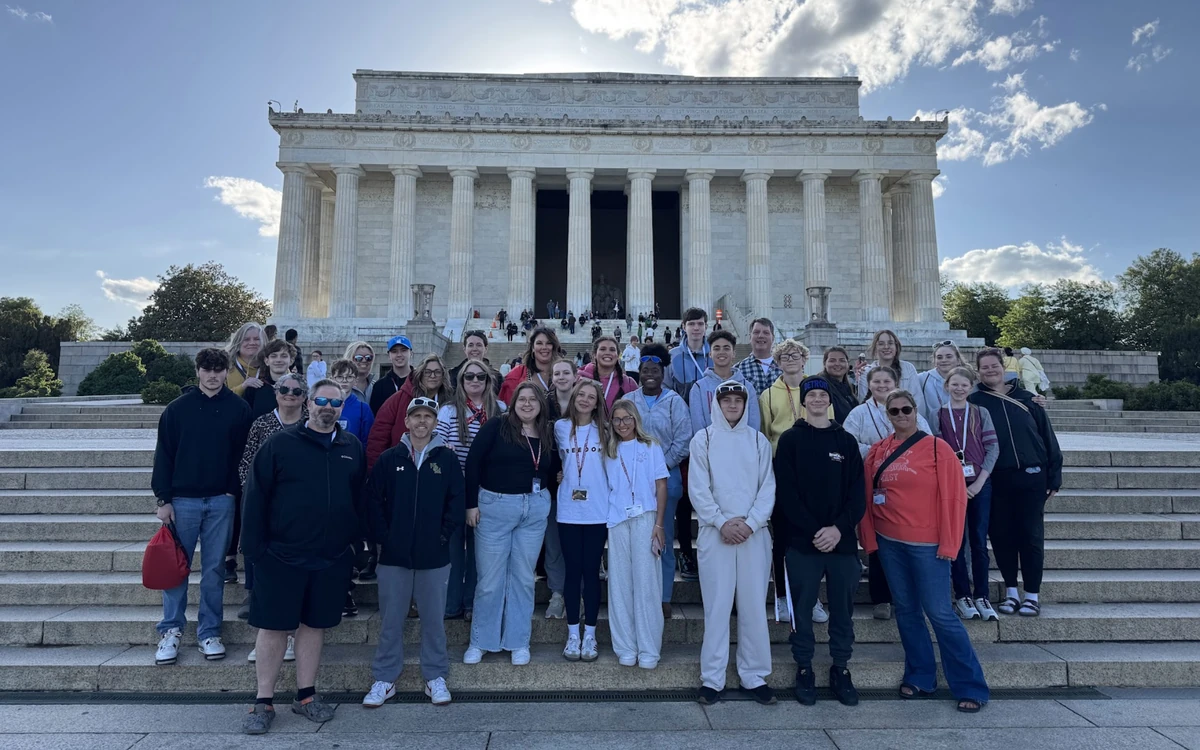
A 4-day school trip with Landmark Educational Tours generally costs $300 to $400+ per student per day, which works out to roughly $1,200 to $1,600+ per student for four days and three nights. That is a fully inclusive price covering transportation, hotel, meals, every scheduled attraction, and a Landmark Tour Director traveling with the group. Airfare, where a trip needs it, is quoted separately because it moves with the calendar in a way ground costs do not. Where you go and how far you travel move that number more than anything else on the list.
Four days is the most common shape for an overnight school trip, and there is a structural reason for that. Counting honestly, a four-day trip gives you two full days on the ground plus an arrival afternoon and a departure morning. A three-day trip gives you one. That is double the full-day time in the destination for roughly a third more money — which is why groups that price both usually end up here.
Below is where that number comes from, what sits inside it, what sits outside it, and how to tell whether a quote you are holding is actually comparable to another one. If you have not settled on a destination or dates yet, how to start planning a student trip covers the steps that come before a price, and you can request a quote at any point at no cost.

4-Day School Trip Cost at a Glance
| Item | What to expect |
|---|---|
| Per student, per day | $300 to $400+, fully inclusive |
| Four days, all in | Roughly $1,200 to $1,600+ per student |
| Nights | Three |
| Full days on the ground | Two, plus an arrival afternoon and a departure morning |
| Airfare | Quoted separately; varies by origin and date |
| Room basis | Students four to a room by default; adults in singles |
| Group size | Ten travelers is the usual threshold for group rates |
| Gratuities | Not included; budgeted separately for your Tour Director and any step-on guides |
| When to book | Nine to twelve months ahead; sixty days before departure is the floor |
Landmark trips across all lengths run about $1,200 to $3,500+ in total, so a four-day trip sits in the lower half of that band. Distance, season and group size are what move a group up it.
Why a 4-Day Trip Is the Most Common Length
The arithmetic of a school trip is front-loaded. Getting your group to the destination and back costs the same whether you stay two nights or three. The Tour Director costs roughly the same. The motorcoach is already contracted. What a fourth day adds is one hotel night and one day of meals — the two cheapest line items on the whole trip.
What the extra day actually buys
On a three-day trip, day one is travel plus an afternoon and day three is a morning plus the ride home. Only day two belongs entirely to you — one full day. Add a fourth day and you have two, which is the point at which an itinerary stops being a highlight reel.
Doubling your full days is a bigger change than the price suggests. Concretely, it is the difference between walking past a museum and spending two hours inside it. It is the difference between seeing the memorials from the coach and standing at them. For most groups the fourth day is where the trip they imagined and the trip they actually take converge.
It is also why groups that fly should almost never book three days. Airfare is a fixed cost that does not care how long you stay, so spreading it across four days instead of three lowers your cost per day without lowering the quality of anything.

What Is Included in a 4-Day Trip Price
Landmark quotes one inclusive price rather than a base rate with add-ons. That makes the headline number look higher than a bare transportation-and-hotel estimate, and it makes it far easier to know what you are actually buying.
| Included | What it covers on a four-day trip |
|---|---|
| Transportation | Motorcoach, and where the itinerary calls for it, Amtrak, metro, subway, transit bus, train and light rail. Airfare can be included but is quoted separately. |
| Hotel accommodations | Three nights. Students four to a room by default, adults in singles, with overnight security. |
| Meals | Included across all four days, apart from any extra meals a group chooses to add. |
| Sites and attractions | Every scheduled admission on your itinerary, booked in advance. |
| Landmark Tour Director | Our employee, background-checked, with your group for all four days and assigned to no one else. |
| Traveler gear | A Landmark string bag, a reusable water bottle and a safety bracelet for each traveler. |
| Support | 24/7 support on the road. Optional travel protection underwritten by battleface Insurance Services is available separately. |
What is not included
Gratuities for your Tour Director and any step-on guides sit outside the price and should go into your budget from the first draft. So should chaperone rooms, which somebody has to pay for — either spread across student pricing or covered by fundraising. Decide which before you publish a number. What is included in a school trip package has the full list.
How to Compare Two 4-Day Quotes
This is where most organizers lose money, and it is not by paying too much. It is by comparing two numbers that were built differently.
A quote can be assembled two ways. One is a base rate, with meals, admissions, staffing and protection added later or left to families. The other is a single inclusive price. The first always looks cheaper on the front page and frequently is not cheaper by departure day.
| Line item | Question to ask | Why it changes the comparison |
|---|---|---|
| Meals | How many per day, and which ones? | Three days of unincluded lunches lands on families and never appears on the quote |
| Attraction admissions | Every site on the itinerary, or only some? | Paid attractions added later change the price after families have committed |
| Staffing | Is someone with the group all four days? | A trip without a dedicated director puts the logistics back on the teacher |
| Travel protection | Included, optional, or unavailable? | Decides what happens if a student cannot travel |
| Room occupancy | Is the price quoted at four students per room? | A quote at three per room is not comparable to one at four |
| Chaperone places | How are adult places priced? | Changes both your room count and your per-student math |
| Gratuities | In the price or on top? | A real cost that often surfaces only in the final week |
Published market ranges for four-day trips usually describe a base-rate structure, which is why an inclusive quote can sit above them and still be the better value. Reconcile the list above before you decide anything. How to choose a reliable student travel agency covers what else to verify.
4-Day, 3-Day and 5-Day Trips Compared
Because the per-day rate is the constant, trip length is the cleanest way to see how a per-student price is built.
| Trip length | Nights | Full days on the ground | Estimated per student |
|---|---|---|---|
| 3 days | 2 | 1 | About $900 to $1,200+ |
| 4 days | 3 | 2 | About $1,200 to $1,600+ |
| 5 days | 4 | 3 | About $1,500 to $2,000+ |
These are planning ranges carried from the $300 to $400+ per student per day rate, not quotes, and they exclude airfare. The column worth reading twice is the third one. Going from three days to four roughly doubles your full days on the ground while raising the price by about a third; going from four to five adds half as much again.
If you are weighing the shorter option specifically, how much a 3-day school trip costs works the same question through at that length. For the general version across destinations and lengths, start with how much a school trip costs.
4-Day School Trip Cost by Destination
Destination changes a four-day price through two things: how far your group travels to reach it, and what hotel rooms cost there for three nights. Admissions matter far less than people assume.
| Destination | What helps the price | What raises it |
|---|---|---|
| Washington, DC | The Smithsonian museums, the National Mall memorials, the National Archives and Arlington National Cemetery charge no admission, so two full days can be filled substantially at no ticket cost (see how many days students need in DC) | Three nights at peak spring rates, which is when most groups want to travel |
| New York City | Public transit reduces how much the motorcoach is doing once you arrive | The highest hotel rates of the common destinations, multiplied by three nights, plus constrained motorcoach parking in Manhattan |
| Philadelphia | Compact and walkable, so less of the day and the budget goes into moving the group | Fewer hotel options directly beside the historic district |
| Boston | The Freedom Trail links many sites on foot at no admission cost | Hotel rates climb in spring and during college graduation weeks |
| Farther destinations | A four-day trip spreads airfare across more days than a three-day one, lowering cost per day | Airfare itself, which is the largest single variable when it applies |
Why the extra night matters more than the extra day
On a four-day trip you buy three hotel nights rather than two. That is a fifty percent increase in your single most season-sensitive cost, which is why the same itinerary can price very differently in April and in October. If your dates are flexible at all, this is where the flexibility pays.
We have worked the numbers through destination by destination in what a school trip to Washington, DC costs and what a school trip to NYC costs. For independent schools specifically, private school field trip costs covers what those groups typically plan around.
What Moves the Price of a 4-Day Trip
| Factor | Effect | Why |
|---|---|---|
| Group size | Large | Motorcoach and Tour Director are fixed costs. Spreading them across more travelers is the biggest single lever most groups have. |
| Distance from the destination | Large | Drive-in and fly-in trips are different products. Airfare hits a four-day trip less hard than a three-day one, but it still dominates when it applies. |
| Time of year | Moderate to large | Peak spring weeks carry the highest hotel rates almost everywhere. Three nights means you feel that three times over. |
| Room occupancy | Moderate | Four students per room is the default, and it compounds across three nights. |
| Paid versus free attractions | Small to moderate | With two full days plus two partial days to fill, attraction choices add up more than they do on a shorter trip. |
Season matters more at four days than at three, simply because you are buying an extra hotel night at whatever the market rate happens to be. A group that shifts from a peak spring week to the fall is making its largest saving on the nights, not the days.
How group size actually works
Group size is the biggest lever because several of the largest costs do not change when you add a traveler. One motorcoach costs the same whether forty or fifty-five students ride it. One Tour Director costs the same either way. Those fixed costs divide across however many people are on the trip, so every additional traveler lowers everyone else's share.
The effect is not smooth, though. A full-size motorcoach typically seats somewhere in the mid-fifties, so the per-student price falls steadily as you fill one coach and then steps up when you need a second. A group of sixty can pay more per student than a group of fifty-five for exactly that reason. If your numbers are near that boundary, it is worth asking your Travel Consultant where the line falls for your itinerary before you finalize your roster.
What a 4-Day Itinerary Holds
The shape is consistent even though the content is not.
Day one
Travel, arrival, and an afternoon or evening activity. Groups that drive usually get more out of this day than groups that fly.
Days two and three
The full days, and the reason to book four rather than three. This is where the substantial sites go, with actual time inside them rather than a photograph from the sidewalk.
Day four
A morning activity and the journey home. Well-built four-day itineraries put something real on this morning rather than treating it as a travel day with a breakfast attached.
Three or four substantial stops a day is what students remember. Six is what produces a group that saw nothing. Our four-day itineraries show how that plays out in practice: a 4-day Washington, DC itinerary, a 4-day trip to NYC, and a 4-day school trip to Quebec City. You can also see the full 4-day Washington, DC program and the rest of our destinations.
What Is the Cheapest Way to Take a 4-Day School Trip?
The cheapest four-day trip is a drive-in destination, traveled outside the peak spring weeks, with a full group and students four to a room. Five choices move a per-student price more than any negotiation will.
- Bring more travelers. Fixed costs spread. The largest lever most groups have.
- Travel outside peak spring weeks. Worth more on a four-day trip than a three-day one, because you are buying three nights.
- Keep students four to a room. It compounds across every night.
- Drive rather than fly where the destination allows it.
- Build around free attractions and choose paid ones for curriculum fit rather than to fill a day.
Booking early protects the itinerary more than the price. Hotel inventory close to a destination sells first, and a late booking often puts a group farther out, which adds motorcoach time to every morning of the trip. When to book a spring 2027 trip goes through the countdown.
How Families Pay for a 4-Day Trip
Once a group commits, your Travel Consultant sends a trip agreement confirming the terms and the payment schedule. Travelers then register on the Landmark portal and pay individually through its payment processor, or the organizer collects centrally by school check. Families can log in and see where they stand at any time, which removes a great deal of chasing from a teacher's week.
The schedule itself starts with a deposit that holds the trip; hotel availability is confirmed at the time of that group deposit rather than before it, which is one reason booking earlier protects the itinerary. Your Travel Consultant confirms the deposit amount and the installment dates in writing in the trip agreement, so you will have exact figures before anything goes out to families.
Most groups pair that schedule with fundraising, which is normal rather than a sign of a trip priced too high. Eight ways schools raise money for field trips covers what actually returns something for the hours spent.
If a family cannot pay
Decide this before you announce a price, and put it in writing. A scholarship line funded by group fundraising, a longer payment schedule, or a confidential hardship process handled through the school all work. Having chosen one early is what keeps a student from quietly opting out.
Getting a Real Number for Your Group
Everything above is a planning range. The number that goes on a permission slip depends on where you leave from, when you travel, how many travelers you have and what you want to see.
The whole planning conversation is free until you agree to proceed — the questions, a custom itinerary, and a written quote you can set beside anyone else's. A Travel Consultant needs your dates or rough window, the destination or destinations you are weighing, and a passenger breakdown of students and adults. Chaperone numbers change your room count, so how many chaperones you need is worth settling early.
We are employee-owned, more than twenty years in, with former classroom teachers on staff. Every trip is private — your group is never merged with another school's. We hold SYTA membership #13443, ABA #84360, IATA 22576046 and California Seller of Travel CST 2168995-50, and we are an approved vendor with districts including New York City, Boston, Miami-Dade, Broward, Newark and Oakland. The full list is on our accreditations and certifications page, and travel safety and support explains what happens if something goes wrong.