Almost every student tour company says it customizes itineraries, and most student travel companies mean something narrower by it than a teacher expects. The difference that matters is whether you are choosing from a menu or starting from a blank page. Landmark Educational Tours builds every trip privately for one group — your dates, your destination, your curriculum — rather than selling a fixed departure with options attached.
The distinction is easy to test and most teachers never think to. Ask a tour operator what happens if you want something that is not on their list. A catalog operator will tell you which package comes closest. A custom operator will ask why you want it and then price it.
This page sets out what can actually be customized on a school trip, what cannot, when each decision has to be made, and the one thing teachers most often get wrong about how customization works. If you are earlier than that, how to start planning a student trip comes first, and you can request a quote at no cost.
Custom Itineraries at a Glance
| Item | Detail |
|---|---|
| Trip type | Private group tours only — your group is never merged with another school’s |
| Itinerary | Built for your group rather than chosen from a catalog |
| Who builds it | A Landmark Travel Consultant, working from your dates, destination and curriculum |
| If you have no plan yet | Your Consultant brings suggestions rather than waiting for you to produce one |
| What it costs to explore | Nothing. Planning, a custom itinerary and a written quote are free until you agree to proceed. |
| Group size | Around ten travelers is the usual industry threshold for group rates |
| Typical cost | $300 to $400+ per student per day, fully inclusive; airfare quoted separately as a variable cost |
| Lead time | Nine to twelve months is comfortable; sixty days before departure is the floor |
What You Can Actually Customize
This is the chart worth keeping. The third column is the one teachers underuse, because most of these decisions have a moment when they are easy and a later moment when they are not.
| Element | How much you control | When to decide |
|---|---|---|
| Destination and dates | Entirely yours | First. Everything else is built on them. |
| Which sites you visit | Entirely yours, within what the calendar allows | During planning, before the itinerary is finalized |
| Trip length | Yours | Early — it moves the price more than almost anything else |
| Curriculum focus | Yours. Tell us the subject and the itinerary is built around it — see our themed programs. | At the first conversation |
| Hotel | You can request a specific hotel to be quoted | During planning; availability is confirmed at group deposit |
| Room assignments | You decide who rooms with whom | Closer to departure, when we request your rooming list |
| Room occupancy | Students in quads and adults in singles by default, adjustable to budget | During planning — it changes the price |
| How the group moves | Motorcoach, rail or local transit, whichever suits the destination | During planning; public transit is sometimes both faster and cheaper |
| Meals | Included, with extra meals addable | During planning |
| Dietary needs | Collected from travelers and reported to restaurants ahead | Travelers enter them on the portal after registration |
| Extra stops, including a souvenir shop | Yes — but only if it is written into the itinerary | During planning. See the section below. |
The Thing Teachers Get Wrong About Customization
Here is the single most useful thing on this page, and it is counterintuitive: a custom itinerary is more fixed on the road, not less.
Because the trip is built specifically for your group, the timing is worked out tightly around your stops — entry times, transfers, meals, the realities of moving forty people. That precision is what makes the day run. It also means anything not written into the itinerary cannot be assumed on the day. A souvenir stop, an extra photo location, half an hour somewhere unplanned: all of these are perfectly possible, and all of them have to be asked for while the itinerary is being built rather than from the coach on day two.
So customization is not flexibility on the road. It is control during planning, which is why the planning sequence matters more on a custom trip than a catalog one. Groups that understand that get the trip they pictured; groups that expect to improvise are the ones who feel the schedule is rigid.
The practical version: write down everything you want on the trip, including the small things, before the itinerary is signed off. Nothing is too minor to mention, and the cheapest time to mention it is now.

How Student Tour Companies Use the Word “Custom”
Customizable and custom are not the same thing, and both words appear on every student travel company’s website, which makes them useless as a filter until you push on them.
Customizable, in practice
A fixed program with choices attached. You pick a departure, then select from options: which of three museums, which evening activity, an upgrade here or there. It is efficient and it works perfectly well for a lot of groups. What it cannot do is accommodate a request that is not on the list.
Custom, in practice
A blank page and a conversation. You describe the group, the dates and what your students have been studying, and someone builds an itinerary from that. The list of options is not the constraint; the calendar and the budget are.
How to tell which you are being offered
Ask one question: what happens if we want something that is not on your list? The answer separates the two immediately. A second, equally revealing question is whether your group travels alone or alongside other schools — a merged departure cannot be genuinely custom, because the itinerary has to serve everybody on it.
Our guide to choosing a reliable student travel agency covers the wider vetting process, and alternatives to WorldStrides for school trips sets out ten questions to put to any provider.
How the Process Works at Landmark
Five steps, and the first four cost nothing.
- You get in touch and a Travel Consultant collects the basics: dates, destination, and a passenger breakdown of students and adults.
- We build an itinerary personalized to what your group wants. If you have never organized a trip, your Consultant suggests what a sensible itinerary looks like rather than waiting for you to produce one.
- You get a written quote that matches the inclusions on that itinerary, so the price and the plan describe the same trip.
- You revise it. This is the stage to use properly — add the small things, swap what does not fit, change the length if the number needs to move.
- You commit, and only then does anything cost you. A trip agreement confirms terms and the payment schedule, and travelers register on the Landmark portal.
The free-until-you-proceed part is worth using rather than rushing. Most groups that end up happy with their itinerary went around step four more than once. More detail on the process is in our FAQ.
What Customization Does Not Change
Being clear about the limits is more useful than a list of possibilities.
- Venue availability. A custom itinerary cannot conjure a slot at a site that is full on your date. Booking earlier is what protects this, not customization.
- Your school calendar. Testing windows, graduation and sports fixtures rule out more weeks than budget ever does.
- The laws of arithmetic. Adding stops adds either time or pressure. A day holds about two substantial stops well and four badly.
- Your district’s requirements. Chaperone ratios and approval processes are set by your school, not by us. How many chaperones you need covers that.
- Group size economics. Around ten travelers is the usual industry threshold for group rates, and no amount of customizing changes how vendors price below it.
- Airfare. It is quoted separately from the trip and moves with the calendar rather than with your itinerary, which matters most on international trips where it is the largest single line.

Does a Custom Itinerary Cost More?
No. Landmark quotes fully inclusive trips at about $300 to $400+ per student per day, or roughly $1,200 to $3,500+ per student in total depending on length and what you include, and that is the price whether the itinerary was built from scratch or closely resembles one we have run before. Airfare is quoted separately, because it moves with the calendar in a way ground costs do not.
What changes the number is the content of the trip rather than the act of customizing it: how long you stay, how far you travel, how many travelers you bring, how many students share a room, and how many paid attractions you choose. That is also why customization is a budget tool rather than a luxury — if the first quote comes back above what families can carry, the itinerary is the thing you adjust.
How much a school trip costs breaks the number down, and what is included in a school trip package lists what the price covers.
What a Custom Itinerary Looks Like in Practice
The clearest illustration is that the same company runs very different weeks for different groups.
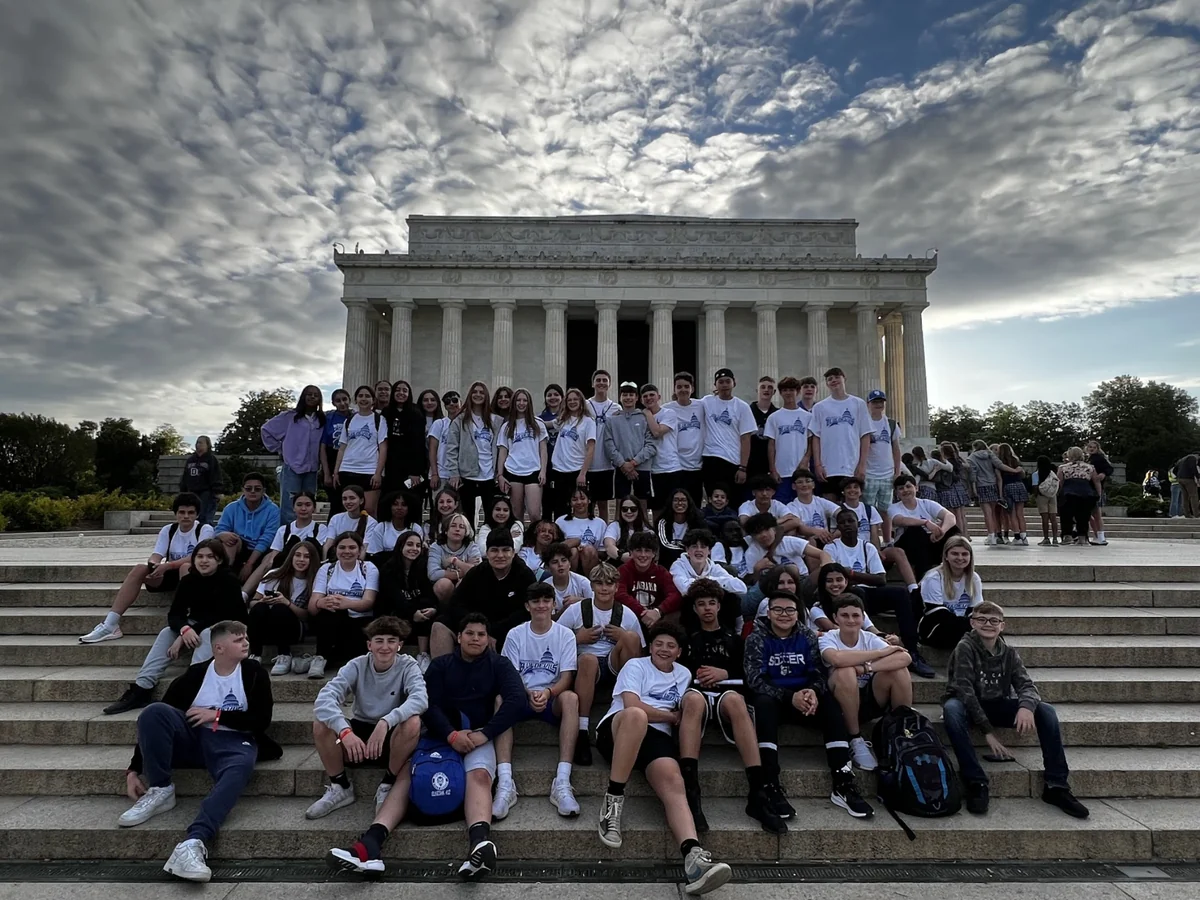
A civics class in Washington spends its days at the Capitol, the National Archives and the memorials, and we build the schedule around the reserved slots those sites allocate. A science group in the same city goes to Air and Space, Natural History and a working NASA facility instead — the itinerary in our guide to the best STEM trips shares a destination with the civics trip and almost nothing else.
The same city, two different weeks
The clearest way to see it is two groups booking Washington, D.C. in the same month.
| An 8th grade civics class | A high school science class | |
|---|---|---|
| Built around | The three branches of government | Aerospace, earth science and working research |
| Morning anchors | The Capitol and the National Archives | Air and Space, and Natural History |
| The off-Mall stop | Arlington National Cemetery | A NASA facility outside the city |
| Evening | The lit memorials on the Mall | The lit memorials on the Mall |
| Pacing | Shorter blocks, a task at each stop | Longer blocks, defined independence |
| What the trip is for | Seeing government operate | Meeting people whose job is the subject |
Same city, same month, same company, same per-student rate. One row is identical — the evening on the Mall, which almost every group should do — and the rest of the week is not comparable. That is what customization looks like when it is real.
The same holds abroad, where it matters more. Landmark runs trips across 48+ countries, and an international itinerary has fewer off-the-shelf options to fall back on, so the custom build is doing more of the work. An arts group in New York builds around Broadway and the museums. A literature group in Salem builds around the town itself. The destinations are the same ones we run constantly; the weeks are not comparable. Browse the destinations and themed programs to see the range, and how many days students need in Washington for how length interacts with all of it.
Start With What Your Students Are Studying
The best custom itineraries begin from a subject rather than a destination. Tell us what your students have been learning, your dates and roughly how many travelers, and a Travel Consultant will build the week around it and send a written quote. Nothing is charged until you agree to proceed, and revising the itinerary before that point is expected rather than an imposition.
We are employee-owned, more than twenty years in, with former classroom teachers on staff — which is a large part of why itineraries here tend to be built around curriculum outcomes rather than a list of famous buildings. Our accreditations are published with their numbers, travel safety and support covers what happens on the road, and our testimonials are from teachers who have already run the trip.