
On a first Washington, D.C. trip students should see the National Mall memorials, the U.S. Capitol, Arlington National Cemetery and the Smithsonian museums — roughly in that order of priority. Everything else is a bonus.
A first Washington DC trip is one of the easiest in the country to get right, because the city puts its best sites within a short walk of one another.
The thing worth thinking about is not which sites to pick, but how many to fit in a day. Washington rewards depth over coverage, and a group that walks the Mall properly at dusk remembers more than one that photographs nine buildings in a day.
The short version:
- The memorials are the trip. Lincoln, Korean War, World War II and Vietnam sit within a short walk of each other and cost nothing but time.
- See the memorials at night if you see them twice. It is the single best hour of a D.C. itinerary.
- The Capitol is the civics lesson, and it needs booking further ahead than anything else.
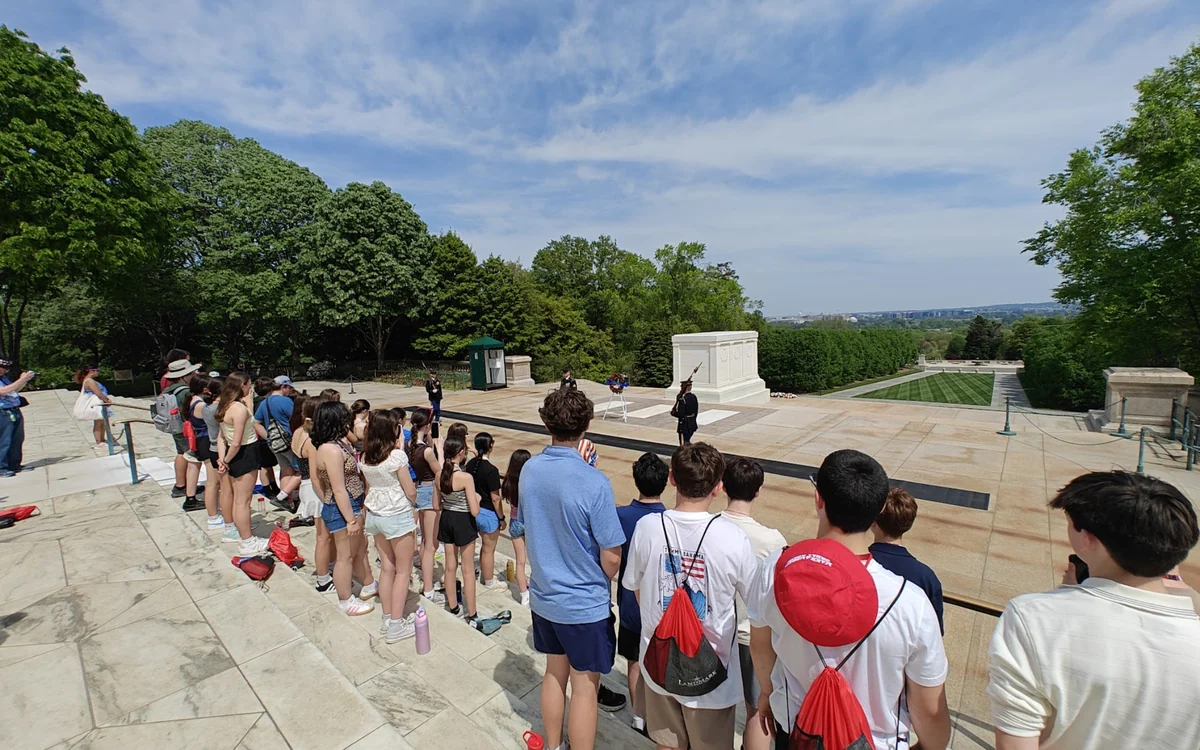
- Arlington changes the tone of the trip. The Changing of the Guard is the moment most students describe afterwards.
- Pace the museums. Groups often fit in several; leaving room to enjoy each one beats racing between them.
- The reservations are handled. Landmark books every ticketed attraction on your itinerary.
Below is the full shortlist with how long each takes and what needs reserving, plus what to skip on a first visit. You can request a quote at no cost before committing to anything.
A First D.C. Trip at a Glance
| Item | Detail |
|---|---|
| The non-negotiables | The National Mall memorials, the U.S. Capitol, Arlington National Cemetery and the Smithsonians |
| Best single hour | The memorials after dark |
| Reservations | Landmark books every ticketed attraction on your itinerary |
| Trip length that fits it | Three days covers the core; four adds Mount Vernon and more museum time |
| Most-booked grade | 8th grade, where the civics and US history curriculum lines up exactly |
| Walking | Significant. The Mall is longer than it looks on a map — comfortable shoes matter more than anything else packed |
| Booking lead time | Six to twelve months. Spring departures fill first |
If you are still deciding how long to go for, how many days you need in Washington works through it.
The Must-See Shortlist for a First Trip
These are the must-see stops for a first visit, ranked by what a group would regret missing. Times are realistic for a school group moving together, not for two adults. For more things to do once the core is covered, see our Washington DC field trip ideas.
| Site why it matters on a first trip | Time |
|---|---|
| Lincoln Memorial The view back down the Mall is the image students keep | 30–45 min |
| Vietnam Veterans Memorial The quietest students get all trip | 20–30 min |
| Korean War Veterans Memorial Steps from Lincoln and often the most affecting | 15–20 min |
| World War II Memorial Completes the Mall walk between Lincoln and the Monument | 20–30 min |
| U.S. Capitol Where the civics unit stops being abstract | 1–1.5 hrs |
| Arlington National Cemetery The Changing of the Guard is what students describe afterwards | 2–3 hrs |
| Smithsonian museums Natural History and American History suit first-timers especially well | 2 hrs each |
| White House exterior and Lafayette Park The group photo everyone expects to come home with | 30 min |
| Martin Luther King, Jr. Memorial Pairs naturally with the Lincoln walk | 20 min |
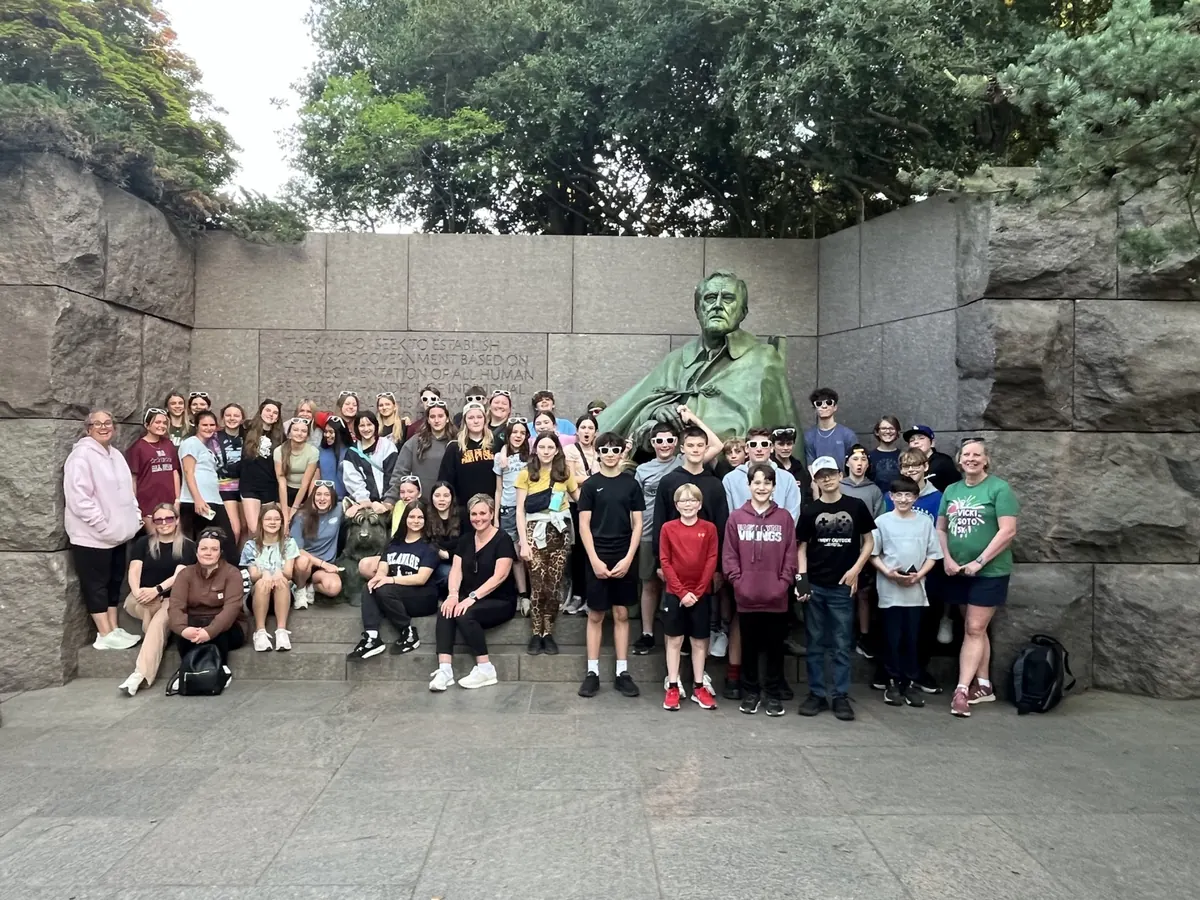
| Franklin Delano Roosevelt Memorial Four outdoor rooms, one per term — the most walkable history lesson in the city | 30–45 min |
| Washington Monument The view from the top takes in the whole Mall at once | 1 hr |
That is more than three days holds. Treat the top six as the trip and the rest as what you add if the schedule allows — our 4-day itinerary shows one way to sequence them.

See the Memorials at Night
If there is one thing to take from this page, it is this.
The National Mall after dark is a different place. The crowds thin, the memorials are lit, and the Lincoln Memorial looking back toward the Washington Monument with the reflecting pool between them is the view that ends up on the year-end slideshow.
It is also the easiest win in D.C. scheduling. Daytime hours are contested by timed entries and museum closing times; evenings are free. A well-built itinerary walks the memorials once in daylight for the reading and the photographs, then returns after dinner for the atmosphere.
Landmark’s own 4-day Washington, D.C. program schedules memorial visits on two separate evenings for exactly this reason.
Choosing Your Smithsonian Museums
There are nineteen Smithsonian museums, and groups often fit several into a trip. The useful question on a first visit is not how many, but which ones and in what order — a little pacing keeps students engaged right through the last one.
For the wider picture once the core is covered, our Washington, D.C. field trip ideas runs through more of the city.
Natural History is a reliable opener: the dinosaur hall and the Hope Diamond carry every age group, and it is the one students most often ask to return to.
American History is the strongest curriculum fit, holding the Star-Spangled Banner and the First Ladies exhibition, and it sits beside Natural History so the two pair naturally.
Air and Space is the one students name in advance. Your Travel Consultant will confirm what is open for your dates when the itinerary is built.
The National Museum of African American History and Culture is among the most powerful buildings in the city, and it rewards a generous slot — many groups give it a half day of its own.

The Bookings Are Handled for You
Washington runs on advance reservations more than almost any other US destination, which is one reason schools use an operator who knows the city. Several of its best sites use timed entry, and the most popular dates go early in the spring season.
On a Landmark trip none of that sits with the teacher. Every ticketed attraction on your itinerary — the U.S. Capitol tour, the Washington Monument, timed museum entries, Arlington arrangements — is reserved by Landmark as part of building the trip, and admission to every scheduled site is included in the price you are quoted.
That is worth knowing when you compare a Landmark itinerary against planning the trip yourself. The sites are the same; the difference is who spends the months securing them.
| Stage | What happens |
|---|---|
| Six to twelve months out | You commit to dates and a headcount. Spring departures fill first, so earlier is better |
| Itinerary build | Your Travel Consultant shapes the days around your curriculum and revises until it is right |
| Reservations | Landmark secures the Capitol tour, timed entries and every other ticketed stop on your schedule |
| Arlington | If your group would like to take part in a wreath laying at the Tomb of the Unknown Soldier, let your Consultant know early so it can be arranged |
| Closer to departure | Rooming lists and dietary needs come in through the traveler portal |
| On the trip | Your Tour Director holds the timings, the entries and the headcounts |
More on what is covered is in what a school trip package includes.
Arlington Changes the Tone
Most first-trip itineraries treat Arlington National Cemetery as one more stop. It is not.
The Changing of the Guard at the Tomb of the Unknown Soldier is the moment students describe when they get home, more often than any museum. The precision of it does something that no amount of explaining beforehand achieves, and groups are almost always quieter afterwards than before.
Build in more time than you think. Arlington is large, hilly, and the walk between the Kennedy gravesite, the Tomb and the Memorial Amphitheater is longer than the map suggests. Two to three hours is realistic for a school group.
It is also worth telling students in advance what the Tomb is and why the guard never stops. Groups that arrive briefed behave differently from groups that arrive curious, and a Landmark Tour Director handles that framing on the coach.
What to Skip on a First Trip
Saying no is what makes the rest of the itinerary work.
A packed museum schedule. Groups can and do visit several, and the trick is pacing rather than a limit — leaving room to enjoy each one beats racing between them.
Anything requiring a long detour. On a first trip the Mall and Arlington are enough. Georgetown and The Wharf are lovely and belong on a second visit.
Over-scheduling the last day. Departure days absorb less than planners want them to. One stop, then home.
Free time without a boundary. Unstructured hours in an unfamiliar city are where first-time groups lose their schedule. Keep free exploration short and bounded — on a Landmark trip it happens in chaperone groups or on the buddy system depending on the age of the group, with the protocols set out on our travel safety page.
How Many Days You Need in Washington DC
A 3-day trip covers the core: the memorials, the Capitol, Arlington and a couple of museums. It is the most common shape for a first visit and it works well.
A 4-day trip gives more room, adding Mount Vernon or extra museum time without compressing anything. Landmark’s four-day program runs memorials on arrival, the Capitol and Smithsonians on day two, Arlington on day three and Mount Vernon on day four.
Two days is a stretch for a first visit. You will see the memorials and one museum, and you will spend the trip hurrying.
Our full breakdowns are in how many days you need and the perfect 4-day D.C. itinerary.
How Much Walking to Expect
This is the question chaperones ask most and the one students are least prepared for.
The National Mall is around two miles end to end, and the memorials sit along it rather than beside each other. A full day on the Mall can run well past the step count anyone expects, and Arlington adds hills on top.
Two things make it easy. Comfortable shoes already broken in matter more than anything else in a suitcase, and a refillable water bottle saves a lot of stopping — every Landmark student receives one along with a string bag and a safety bracelet.
Spreading the Mall across two shorter visits rather than one long push also helps, which is part of why evening memorial walks work so well.
Which Grades This Suits
Washington is the most-booked 8th grade trip in the country, because the civics and US history sequence lands exactly there and students are old enough for the walking and the subject matter.
For middle school generally, keep the museum count low and the memorial time high. Younger students engage more with scale and story than with exhibition text.
For high school, the same core works but the conversation changes — Arlington, the Holocaust Memorial Museum and the African American History museum all land differently with older students, and a civics-focused itinerary can go deeper. See our civics student tour.
If you are comparing cities first, the best 8th grade trip destinations puts Washington against the alternatives.
What a Landmark D.C. Trip Includes
A package typically covers a private group tour for your group only, a custom itinerary, transportation, student-appropriate hotel accommodations, admission to every scheduled site, the meals named in the itinerary, a professional Tour Director traveling with your group, and restaurant and driver gratuities.
Every scheduled site is pre-booked, which matters more in Washington than almost anywhere else — the reservations are handled as part of building the trip.
On average, Landmark’s fully inclusive trips range from $300 to $400+ per traveler per day, or about $1,200 to $3,500+ total for an all inclusive package. Airfare is an additional variable cost. Our Washington, D.C. trip cost breakdown has the detail.
Who Is Landmark Educational Tours?
Landmark Educational Tours is a 100% employee-owned domestic and international educational travel company headquartered at 1 Central Street, Suite 205, Middleton, Massachusetts, reachable at (888) 886-2781.
Landmark plans and operates fully managed, custom class trips for public districts alongside private, religious, prep and independent schools, and runs several Washington, D.C. programs from two days upward. Every trip is a private group tour, and each group travels with a Landmark Tour Director who is an employee of the company.
Credentials: SYTA Member #13443, ABA Member #84360, IATA Code 22576046, BBB Business ID 544197, California Seller of Travel 2168995-50, and ETOA membership. More on the about Landmark page.
Planning a First D.C. Trip
Three things make a first conversation productive: a rough headcount, how many days you can release students, and your preferred season.
A Landmark Travel Consultant will build the itinerary around your curriculum and handle the booking deadlines, free, with nothing held until you say so.
If you have not started, how to start planning a student trip is the step before choosing sites, and the top monuments and memorials goes deeper on the Mall itself.