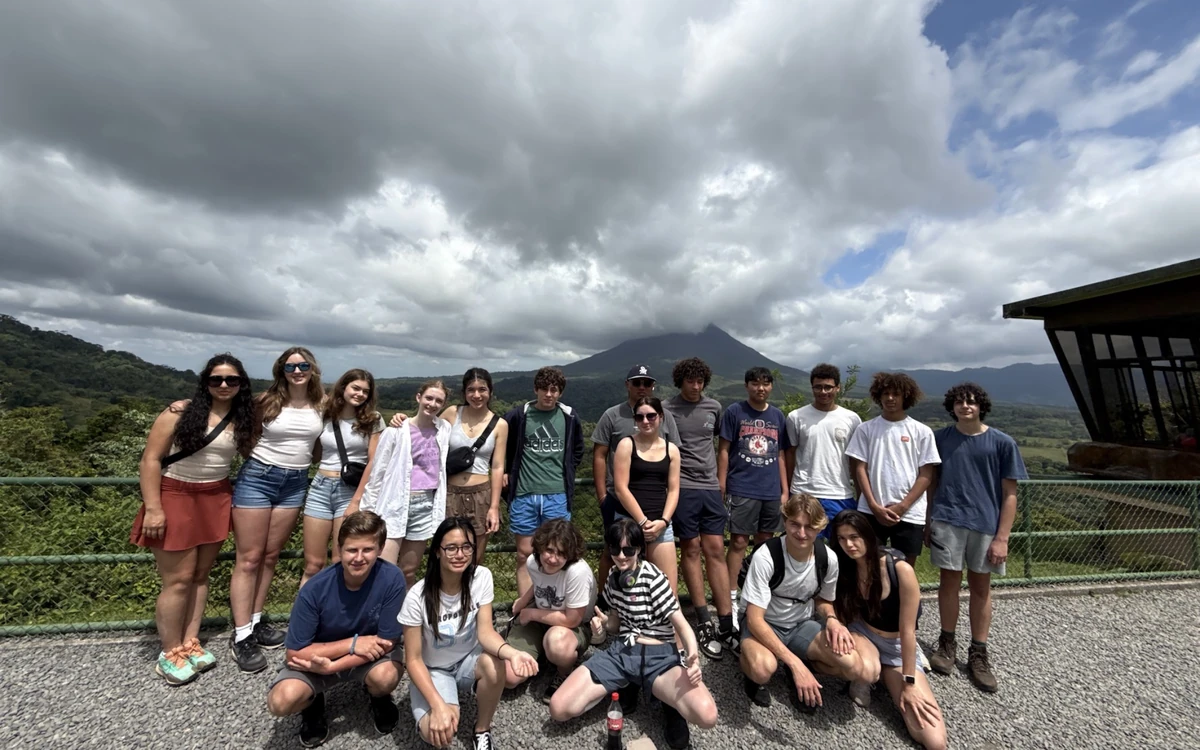
Costa Rica works for a STEM trip because the science is the destination rather than an exhibit about it. Students take readings in a working biological reserve, stand on an active volcanic landscape, move through rainforest canopy at height, and see a national conservation policy that is measurable rather than aspirational.
That is the difference between a science museum and a field site. A museum explains an ecosystem; Costa Rica puts students inside one for a week.
The short version:
- A real field station — Tirimbina is a research reserve, not an attraction
- Earth science you can stand on — Arenal, and geothermal water
- Canopy access — hanging bridges and ziplines reach a layer you cannot otherwise see
- River systems — the Sarapiquí as hydrology rather than a ride
- Conservation with numbers — forest cover held at 52% since 2010
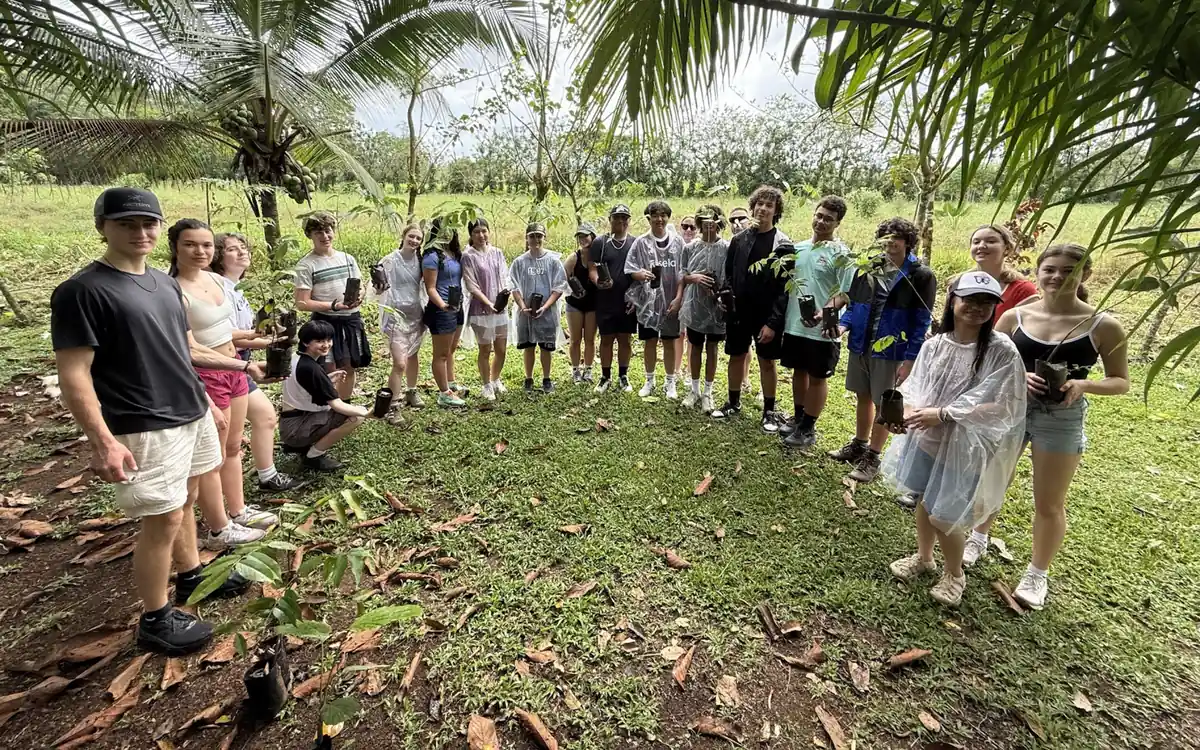
- Hands in the work — a reforestation program, not a talk about one
Below is each one, what students actually do, and what it costs. You can request a quote at no cost before committing to anything.
Costa Rica STEM Trips at a Glance
| Item | Detail |
|---|---|
| Strongest STEM fit | Biology, ecology, environmental science and earth science. Physics and engineering have a real role too |
| The field station | Tirimbina, a biological reserve in Sarapiquí with resident biologists and rainforest trails |
| Earth science | Arenal’s volcanic landscape and geothermally heated water |
| Typical trip length | Six or seven days, which is what the travel time justifies |
| Language bonus | Spanish, used daily. Useful given how many U.S. schools teach it |
| Documentation | International travel, so every traveler needs a passport |
| Landmark programs | Two: a six-day and a seven-day Costa Rica school trip |
Why a Field Station Beats a Science Museum
This is the argument that separates Costa Rica from a domestic STEM trip, and it is worth making precisely.
Landmark’s seven-day itinerary includes the Tirimbina Biological Reserve, which describes itself as a tropical science resource where education and research combine. Its biologists work on site, it runs free environmental education for local communities, and its rainforest trails cross three hanging bridges.
That matters because students are not looking at an interpretation of a rainforest. They are in one, with people whose job is studying it, on trails built for that purpose.
A domestic science museum can do many things better: controlled demonstrations, engineering exhibits, space hardware. What it cannot do is put a student in a tropical forest with a biologist for an afternoon.
| Six day | Seven day | |
|---|---|---|
| Field station | Not included | Tirimbina |
| Replanting | Not included | Included |
| Volcanic landscape | Arenal | Arenal |
| Canopy access | Bridges, zipline | Bridges, zipline |
| River work | Sarapiquí | Sarapiquí |
| Service element | Local school | Replanting |
The seven-day program is the stronger science trip; the six-day trades the field station for a shorter calendar.
Earth Science You Can Stand On
Arenal is the anchor for the geology half of the trip, and it does work no classroom model does.
Students see a volcanic cone, the landscape it built, and a lake in the same view. The hot springs on the itinerary are geothermally heated by the same system, which turns an abstract heat-transfer diagram into water students are standing in.
Our Costa Rica school trip overview covers the wider itinerary. For an earth science class, the sequence is the lesson: magma, landform, groundwater, surface water, and the ecosystems that grow on volcanic soil, all within a few miles.
The Canopy Is a Separate Ecosystem
Rainforest is layered, and the layer with most of the life in it is the one students never reach on a walking trail.
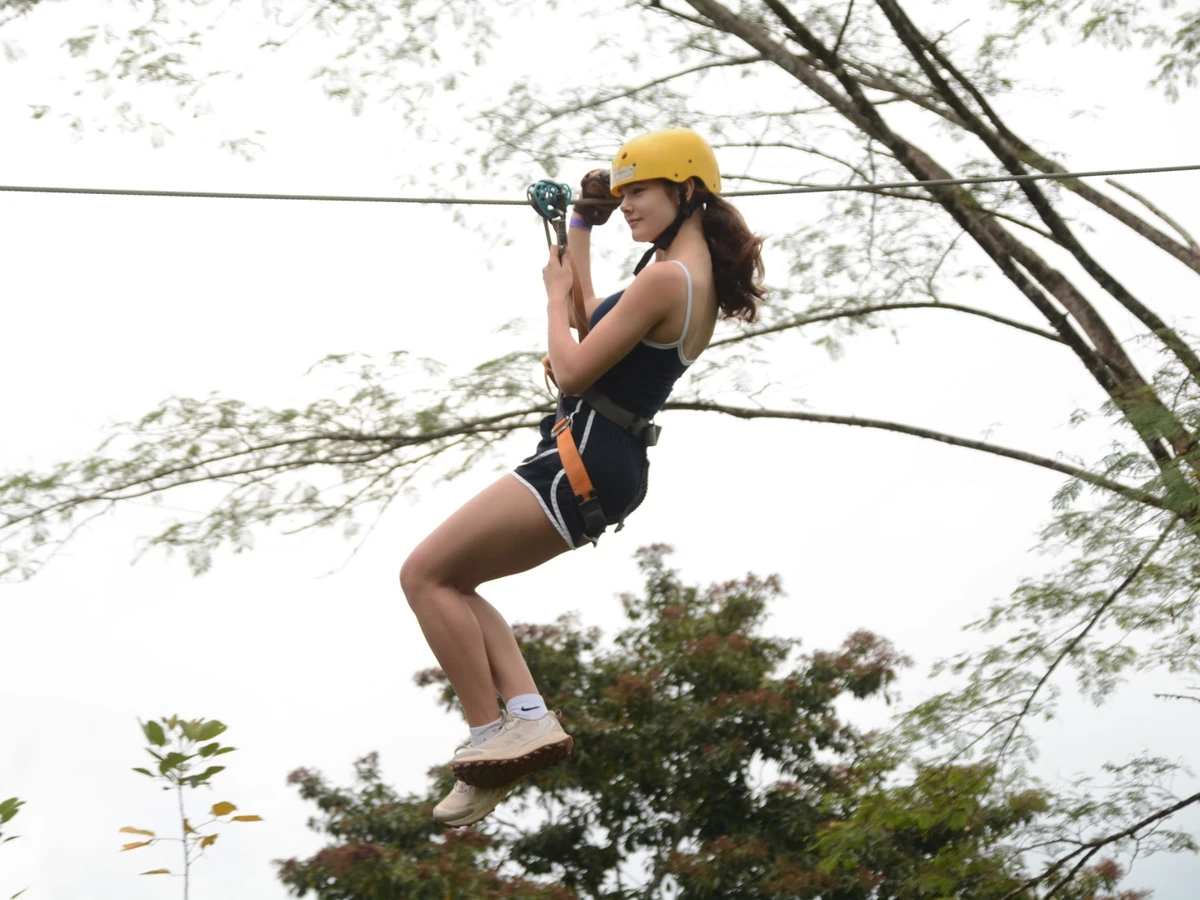
Hanging bridges and zipline platforms exist for tourism, but they solve a genuine research problem: canopy access. Students who are told that before they clip in understand why the structures are there.
This is one of the things travel teaches that a classroom cannot. It is also the clearest physics on the trip. A zipline is potential energy converted to kinetic, with friction and braking as the design constraint, and students are the mass in the equation.
Rivers, and Why the Sarapiquí Is Not Just a Raft Ride
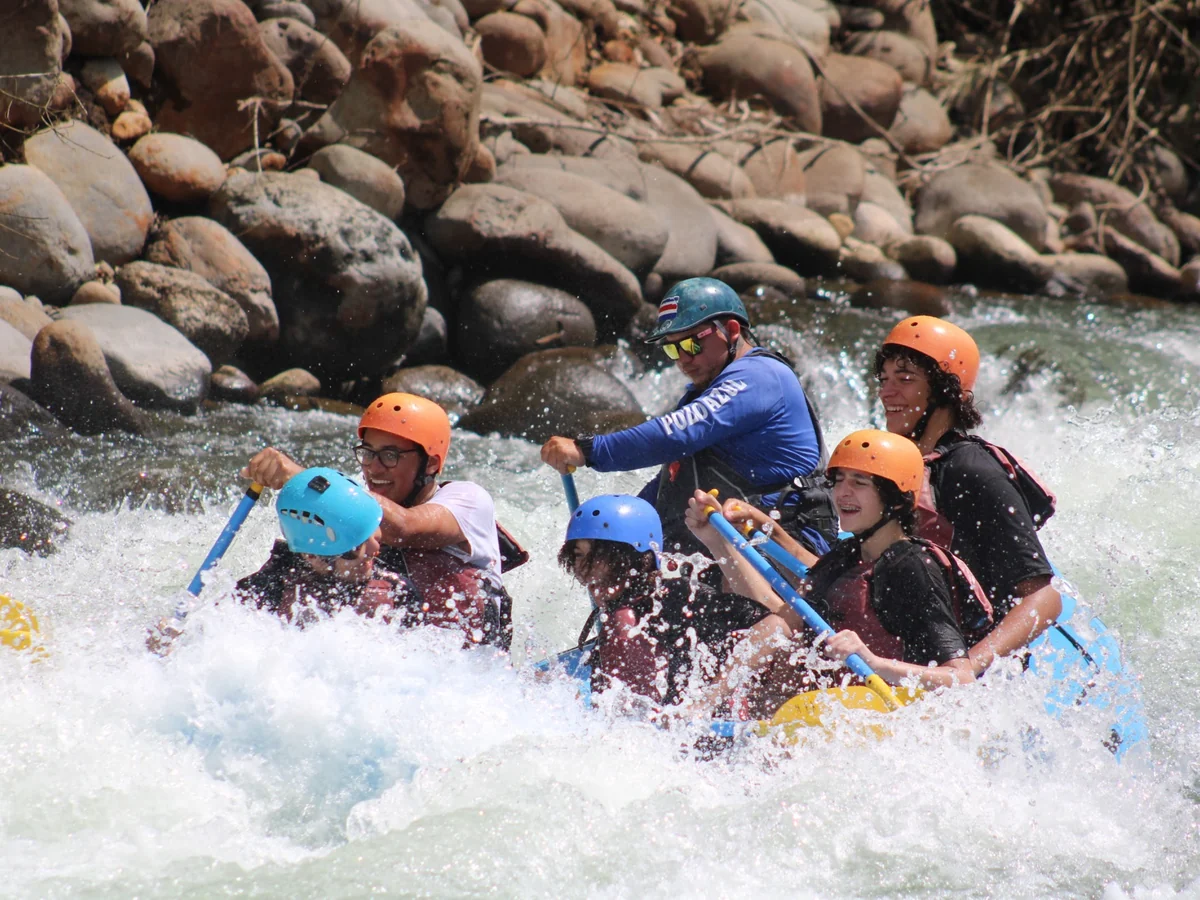
The rafting day reads as recreation on an itinerary. Framed properly it is a hydrology lesson students will not forget.
A tropical river moving through volcanic terrain shows erosion, deposition, gradient and discharge at full scale and in real time. The boulders students are steering around were moved by that water.
Tell a class to watch where the water is fast and where it is slow, and why, and the same students who were braced for a theme-park ride start reading a river.
Conservation With Numbers Attached
Costa Rica is the rare place where an environmental science unit has a measurable national case study rather than a slogan.
Its profile with the Convention on Biological Diversity reports that forest cover has been maintained at 52% since 2010, which is a figure students can interrogate: what counts as forest, who measures it, and what happened before 2010.
A note on the statistic you will see everywhere. Nearly every page about Costa Rica claims the country holds about 5% of the world’s biodiversity on 0.03% of the earth’s surface. We went looking for the source and could not establish one, and the figures quoted vary between roughly 4% and 6%.
Costa Rica is genuinely among the most biodiverse countries on earth, and that does not need an untraceable number. Its own CBD profile notes that a system for comprehensively monitoring the country’s biodiversity is absent, which is probably why nobody can source the claim precisely.
That is a better lesson than the statistic would have been: students get a real example of checking a number everyone repeats.
Students With Their Hands in the Work
Two items on Landmark’s itineraries move students from observing to participating.
The seven-day trip includes a reforestation program, which is the difference between hearing about restoration ecology and planting into it. The six-day trip includes volunteer service at a local school.
The cacao and chocolate tours are more scientific than they sound. Fermentation, drying and roasting are controlled chemical processes, and a cacao pod to finished chocolate sequence is applied food science.
Our guide to what students learn on a Costa Rica field trip covers the non-STEM subjects the same trip serves.
How It Maps to a STEM Curriculum
| Subject | Where it happens |
|---|---|
| Biology and ecology | Tirimbina Biological Reserve, hanging bridges, crocodile safari, canopy and understory |
| Environmental science | Reforestation program, national forest-cover policy, protected-area model |
| Earth science | Arenal’s volcanic landscape, geothermal water, volcanic soils |
| Physics | Ziplines and canopy structures: energy, friction and braking |
| Chemistry | Cacao fermentation, drying and roasting as controlled processes |
| Geography and hydrology | The Sarapiquí: erosion, deposition, gradient and discharge |
| Data and fieldwork skills | Observation, recording and comparison, which travel well back to the lab |
Our best STEM trips for middle and high school students sets Costa Rica against the domestic options.
What Costa Rica Is Not Good For
Worth saying plainly, because a trip sold as right for everything is right for nothing.
If your focus is space, aeronautics, robotics or computing, a domestic trip serves you better. Houston, Huntsville and the Smithsonian do things Costa Rica cannot.
It is also a longer and more expensive trip than a domestic one, and it needs passports. For a first-ever group trip, that is a lot of firsts at once, and the international destinations guide sets out the alternatives.
Costa Rica earns its place when the subject is living systems, earth systems or environmental science. For those, little else comes close. Our Italy and France comparison applies the same test to a humanities trip.
What a Landmark Trip Costs and Includes
A package typically covers a private group tour for your group only, a custom itinerary built around your curriculum, transportation, student-appropriate hotel accommodations, admission to every scheduled site, the meals named in the itinerary, a professional Tour Director traveling with your group, and restaurant and driver gratuities.
On average, Landmark’s fully inclusive trips range from $300 to $400+ per traveler per day, or about $1,200 to $3,500+ total for an all inclusive package. Airfare is an additional variable cost.
| Item | Detail |
|---|---|
| Per traveler, per day | $300 to $400+, fully inclusive |
| All inclusive package | About $1,200 to $3,500+ in total |
| Ground transport and hotels | Included, with student-appropriate accommodations |
| Guided activities and entries | Included for every scheduled site, booked by Landmark |
| Meals named in the itinerary | Included, with restaurant and driver gratuities covered |
| Tour Directors | Included. Itineraries pair a U.S. based Tour Director with a Costa Rican one |
| Airfare | Quoted separately. A variable cost depending on origin and dates |
| Travel protection | Optional coverage, bought separately rather than included |
| Passports | Not included. Families arrange their own, and everyone flying needs one |
See what a school trip package includes.
Who Is Landmark Educational Tours?
Landmark Educational Tours is a 100% employee-owned domestic and international educational travel company headquartered at 1 Central Street, Suite 205, Middleton, Massachusetts, reachable at (888) 886-2781.
Landmark plans and operates fully managed, custom class trips for public districts alongside private, religious, prep and independent schools. Every trip is a private group tour, and each group travels with a Landmark Tour Director who is an employee of the company.
Landmark is a member of the Student & Youth Travel Association (#13443), along with ABA Member #84360, IATA Code 22576046, BBB Business ID 544197, California Seller of Travel 2168995-50, and ETOA membership. More on the about Landmark page.
Planning a Costa Rica STEM Trip
Four things make a first conversation productive: a rough headcount, the year group, the specific unit the trip supports, and whether your travelers already hold passports.
A Landmark Travel Consultant will build the itinerary around the science you are teaching, free, with nothing held until you say so.
See our Costa Rica school trips, including the seven-day program that includes Tirimbina, and how to start planning a student trip.